
Table of Contents
Introduction
Lightweight Leave In Conditioner is an essential hair care product for people who want soft, smooth, manageable, and healthy-looking hair without making it feel heavy or greasy. Unlike traditional rinse-out conditioners, leave-in conditioners remain in the hair after washing and provide ongoing moisture, protection, and nourishment throughout the day.
Many people struggle with dry ends, frizz, tangles, and hair that becomes difficult to manage after shampooing. Regular conditioners can help, but they may not provide enough moisture or protection between washes. This is where a lightweight leave-in conditioner can make a difference.
A lightweight formula is especially useful for people with fine hair, thin hair, wavy hair, or hair that becomes oily easily. It provides hydration without weighing down the natural movement and volume of the hair.
However, choosing the right product is important. Some formulas are designed mainly for hydration, while others focus on detangling, frizz control, heat protection, or improving softness.
In this guide, you will learn what a lightweight leave-in conditioner is, how it works, its benefits, how to use it correctly, and how to choose the right formula for your hair type.
What Is a Lightweight Leave-In Conditioner?
A lightweight leave-in conditioner is a hair care product designed to provide moisture, softness, and manageability without leaving heavy buildup. It is applied after shampooing and conditioning, and it does not need to be rinsed out.
Unlike thick creams and traditional conditioners, lightweight formulas usually have a thinner consistency. They may come in sprays, mists, lotions, or lightweight creams.
These products help maintain moisture in the hair, reduce tangles, improve smoothness, and make styling easier.
The main purpose is to provide conditioning benefits while keeping the hair feeling natural and flexible.
For example, someone with fine hair may find that a thick leave-in cream makes their hair look flat. A lightweight spray can offer enough conditioning to improve softness without removing natural volume.
How Does a Lightweight Leave-In Conditioner Work?
Hair can lose moisture because of frequent washing, heat styling, environmental exposure, and chemical treatments. When hair becomes dry, the outer cuticle can feel rough, making strands more likely to tangle and appear frizzy.
A lightweight leave-in conditioner works by depositing conditioning ingredients onto the hair surface. These ingredients help improve smoothness, reduce friction, and make individual strands easier to manage.
Most formulas contain a combination of the following ingredients:
1. Humectants
Humectants help attract and retain moisture. Common examples include:
- Glycerin
- Panthenol
- Aloe vera
- Propanediol
These ingredients can help improve the feeling of hydration and softness.
2. Conditioning Agents
Conditioning agents help reduce friction between hair strands. They make hair easier to comb and can improve smoothness.
Examples include:
- Behentrimonium chloride
- Cetrimonium chloride
- Polyquaternium ingredients
3. Lightweight Oils
Some leave-in conditioners contain small amounts of lightweight oils to improve softness and reduce dryness.
Examples include:
- Argan oil
- Jojoba oil
- Grapeseed oil
The ideal formula depends on your hair type and how much moisture your hair needs.
4. Silicones
Certain formulas contain silicones that coat the hair surface, helping reduce friction and improve smoothness.
Ingredients such as dimethicone and amodimethicone can help with detangling and frizz control. They are not automatically bad for hair; the important thing is choosing a formula that works with your hair and washing routine.
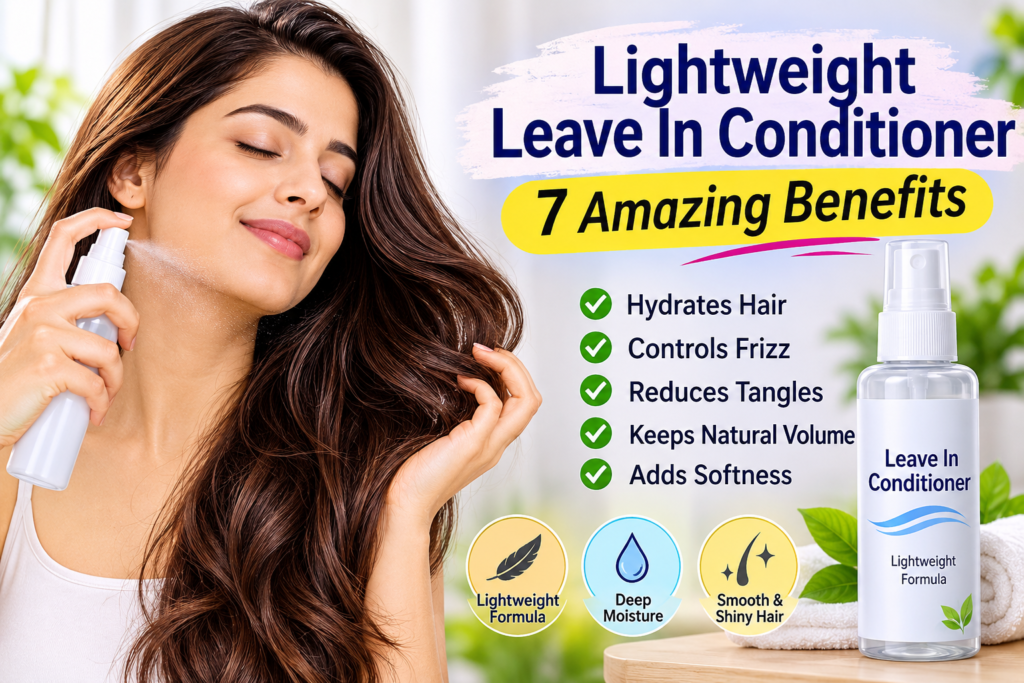
10 Benefits of Lightweight Leave-In Conditioner
A good lightweight leave-in conditioner can improve the appearance and manageability of your hair in several ways.
1. Provides Lightweight Hydration
One of the biggest benefits is that it helps improve hair softness without creating a heavy feeling.
People with fine or thin hair often avoid moisturizing products because they worry about losing volume. A lightweight formula provides conditioning while helping the hair maintain its natural movement.
It is particularly helpful for dry ends that need extra care between wash days.
2. Reduces Frizz
Frizz can occur when hair becomes dry, damaged, or exposed to humidity. Rough hair strands may absorb moisture from the surrounding environment, causing them to swell and appear less smooth.
A leave-in conditioner helps smooth the hair surface and reduce friction.
Although it cannot completely prevent humidity-related frizz, the right formula can make hair look more controlled and polished.
3. Makes Detangling Easier
Knots and tangles are common problems, especially for long, curly, and wavy hair.
A lightweight leave-in conditioner improves slip, allowing a comb or brush to move through the hair more easily.
This can reduce unnecessary pulling during detangling and help prevent mechanical breakage.
For best results, apply the product to damp hair and gently detangle from the ends toward the roots.
4. Improves Hair Softness
Dry hair often feels rough and difficult to style. Conditioning ingredients help smooth the strands and improve their texture.
With regular use, hair may feel softer, more flexible, and easier to manage.
However, leave-in conditioner does not permanently repair damaged hair. It mainly improves the surface condition and appearance of the strands.
5. Helps Maintain Natural Volume
Heavy styling creams and thick conditioners can make fine hair look flat.
Lightweight leave-in formulas are generally easier to distribute through fine strands without creating excessive weight.
They can help improve softness while allowing natural volume and movement to remain visible.
6. Supports Healthy-Looking Ends
The ends of your hair are usually older than the roots and may experience more friction, brushing, and environmental exposure.
As a result, they can become dry and rough.
Applying a small amount of lightweight leave-in conditioner to the ends can improve softness and reduce tangling.
It may also help minimize breakage caused by friction, although it cannot permanently seal split ends.
7. Makes Styling Easier
Hair that is properly conditioned is generally easier to style.
A leave-in conditioner can help improve manageability before blow-drying, air-drying, or creating natural hairstyles.
Some products also contain heat-protective ingredients, but you should only rely on a leave-in conditioner for heat protection when its label specifically states that it provides this benefit.
8. Helps Control Flyaways
Flyaways can make hairstyles look messy, especially in dry or humid weather.
Lightweight conditioning ingredients can smooth individual strands and make the hair appear more polished.
Avoid applying too much product near the roots, as this may make fine hair look greasy.
9. Improves Hair Flexibility
Dry strands can feel stiff and rough. Conditioning products help improve the feel of flexibility by reducing friction and making the hair easier to handle.
This is useful for people who frequently brush, comb, or style their hair.
10. Provides Daily Hair Care Convenience
A lightweight leave-in conditioner is easy to include in a regular hair care routine.
Many formulas can be applied after every wash, while some are suitable for occasional use on dry hair.
Because they do not require rinsing, they are convenient for people with busy schedules.
Best Lightweight Leave-In Conditioner for Different Hair Types
Not every hair type needs the same level of conditioning. Understanding your hair texture and moisture requirements can help you choose a better product.
Lightweight Leave-In Conditioner for Fine Hair
Fine hair can become flat when exposed to heavy oils, thick creams, and rich styling products.
Look for:
- Lightweight spray formulas
- Water-based products
- Panthenol
- Aloe vera
- Lightweight conditioning agents
Apply a small amount mainly to the middle lengths and ends.
Avoid using too much product near the scalp because fine hair can become oily-looking more quickly.
Lightweight Leave-In Conditioner for Thin Hair
Thin hair may benefit from products that improve softness without reducing its natural volume.
Choose lightweight mists or sprays rather than thick leave-in creams.
Look for formulas that provide detangling and light conditioning without leaving a sticky residue.
Lightweight Leave-In Conditioner for Wavy Hair
Wavy hair often needs moisture to maintain smoothness and natural definition.
A lightweight leave-in conditioner can help reduce frizz and make waves easier to style.
Choose products containing aloe vera, panthenol, or suitable conditioning ingredients.
Apply evenly to damp hair and gently scrunch the waves to encourage their natural pattern.
Lightweight Leave-In Conditioner for Curly Hair
Curly hair often experiences dryness because natural scalp oils have more difficulty traveling along the curved strands.
A lightweight formula can help with detangling and softness, particularly for loose curls.
People with tighter curls may need a richer leave-in product if a very light spray does not provide enough moisture.
Lightweight Leave-In Conditioner for Dry Hair
Dry hair generally requires additional conditioning.
Look for formulas containing moisturizing ingredients and small amounts of suitable oils.
Apply the product to damp hair, paying extra attention to dry ends.
If your hair is extremely dry, you may benefit from combining a lightweight leave-in conditioner with a rinse-out conditioner or occasional deep-conditioning treatment.
Lightweight Leave-In Conditioner for Damaged Hair
Heat styling, coloring, bleaching, and chemical treatments can leave hair rough and fragile.
A lightweight leave-in conditioner can improve softness, reduce tangling, and make damaged hair easier to manage.
Look for products with conditioning agents, proteins, or ingredients designed for damaged hair.
Remember that no leave-in conditioner can completely reverse structural damage. Trimming severely split ends and reducing excessive heat exposure may also be necessary.
How to Choose the Best Lightweight Leave-In Conditioner
Choosing a suitable formula requires more than looking at the product name. You should consider your hair texture, scalp condition, styling habits, and moisture requirements.
1. Understand Your Hair Texture
Your hair texture affects how much conditioning it needs.
Fine hair usually benefits from sprays and lightweight lotions, while thick or coarse hair may need a more nourishing cream.
Choose a product that provides enough moisture without making your strands feel coated.
2. Check the Ingredient List
Ingredients can tell you a lot about how a product may perform.
For lightweight hydration, consider:
- Glycerin
- Panthenol
- Aloe vera
- Lightweight conditioning agents
- Small amounts of suitable oils
If you want better detangling, look for conditioning ingredients that improve slip.
Remember that the complete formulation matters more than one individual ingredient.
3. Consider Your Scalp Condition
If your scalp becomes oily quickly, avoid applying leave-in conditioner directly to the roots unless the product specifically recommends it.
Concentrate on the middle lengths and ends.
If your hair is dry but your scalp is oily, this approach can provide conditioning where it is needed without adding unnecessary product near the scalp.
4. Choose the Right Formula
Lightweight leave-in conditioners are available in different forms.
| Formula | Best suited for |
|---|---|
| Spray | Fine and thin hair |
| Mist | Light daily conditioning |
| Lightweight lotion | Normal and slightly dry hair |
| Lightweight cream | Wavy and moderately dry hair |
| Detangling spray | Tangled and long hair |
The best option depends on your hair’s individual needs.
5. Check for Heat Protection
If you frequently use a hair dryer, straightener, or curling iron, consider a leave-in conditioner that specifically provides heat protection.
Not every leave-in conditioner protects against heat.
Always check the product instructions for the recommended temperature limits and application method.
6. Avoid Excessive Product Buildup
Using too much leave-in conditioner can make hair feel sticky, coated, or greasy.
Choose a formula that can be easily distributed through your hair.
If your hair starts feeling heavy, reduce the amount or use a suitable clarifying shampoo occasionally.
How to Use Lightweight Leave-In Conditioner Correctly
Using a leave-in conditioner correctly helps you get better results without making your hair feel greasy.
Follow these simple steps.
Step 1: Wash Your Hair
Start by washing your hair with a shampoo that suits your scalp and hair type.
Focus on cleaning the scalp rather than aggressively scrubbing the lengths.
Step 2: Apply Rinse-Out Conditioner
Use your regular conditioner if your hair needs additional softness and moisture.
Apply it mainly to the middle lengths and ends, following the product instructions.
Rinse thoroughly.
Step 3: Remove Excess Water
After washing, gently squeeze excess water from your hair using a soft towel or microfiber towel.
Avoid rubbing your hair aggressively because wet strands are more vulnerable to damage.
Step 4: Apply Leave-In Conditioner
Take a small amount of lightweight leave-in conditioner.
For spray formulas, distribute the product evenly over damp hair. For lotions or creams, rub a small amount between your palms before applying.
Start with less product. You can always add a little more if necessary.
Step 5: Distribute the Product
Use your fingers or a wide-tooth comb to distribute the conditioner evenly.
Pay special attention to dry, tangled, or damaged ends.
Avoid applying excessive amounts to your roots.
Step 6: Style Your Hair
After application, style your hair according to your preference.
You can allow it to air-dry or use a hair dryer if the product is suitable for your styling routine.
If you use heat tools, make sure you have appropriate heat protection.
Lightweight Leave-In Conditioner vs. Regular Conditioner
Although both products help condition hair, they serve slightly different purposes.
| Feature | Leave-In Conditioner | Regular Conditioner |
|---|---|---|
| Application | After washing | During washing |
| Rinsing | Usually not rinsed | Rinsed out |
| Main purpose | Ongoing conditioning | Immediate conditioning |
| Texture | Often lightweight | Can be thicker |
| Detangling | Helps between washes | Helps after shampooing |
| Usage | According to product directions | Usually after shampooing |
A regular conditioner provides conditioning during the washing process, while a leave-in conditioner remains on the hair.
You can use both products in the same routine if your hair needs additional moisture.
Lightweight Leave-In Conditioner vs. Hair Serum
Many people confuse leave-in conditioners with hair serums because both can improve the appearance of hair.
However, they are not exactly the same.
| Feature | Leave-In Conditioner | Hair Serum |
|---|---|---|
| Main purpose | Conditioning and moisture | Smoothness and finishing |
| Texture | Spray, lotion, or cream | Usually silicone-based or oil-based |
| Detangling | Often helps | Depends on formula |
| Frizz control | Yes | Yes |
| Application | Damp hair, sometimes dry hair | Damp or dry hair, depending on instructions |
A leave-in conditioner is generally used to condition and improve manageability, while a serum is often used as a finishing product to smooth the hair and control flyaways.
Some people use both, but applying too much of either product can create buildup.
Common Mistakes to Avoid
Even a good lightweight leave-in conditioner may not deliver the expected results if you use it incorrectly.
Here are some common mistakes to avoid.
1. Applying Too Much Product
Using more conditioner does not necessarily produce better results.
Excessive application can make hair greasy, sticky, or flat.
Start with a small amount and increase it only when needed.
2. Applying It Directly to the Scalp
Most leave-in conditioners are designed for the hair lengths rather than the scalp.
Applying too much near the roots may make your hair appear oily.
Follow the manufacturer’s instructions.
3. Using the Wrong Formula
A product designed for thick, coarse hair may feel too heavy on fine hair.
Similarly, an extremely lightweight spray may not provide enough moisture for very dry curls.
Always consider your hair’s texture and conditioning needs.
4. Not Distributing It Evenly
Applying conditioner to only one section can result in uneven texture.
Use your fingers or a wide-tooth comb to distribute it gently.
5. Expecting Permanent Hair Repair
Leave-in conditioners can improve softness and manageability, but they cannot permanently repair split ends or completely restore severely damaged hair.
Use them as part of a broader hair care routine.
How Often Should You Use a Lightweight Leave-In Conditioner?
The ideal frequency depends on your hair type, product formulation, and styling routine.
Fine hair: You may benefit from applying a small amount after washing. Avoid excessive daily application if your hair becomes flat.
Dry hair: Regular application after washing may help maintain softness and reduce tangling.
Wavy hair: Use it after wash days or whenever your hair needs additional conditioning.
Curly hair: You may need leave-in conditioner more frequently, depending on your curl pattern and moisture requirements.
Damaged hair: Use a suitable formula according to its instructions, especially when your hair is frequently exposed to heat or chemical treatments.
There is no universal rule that everyone must use leave-in conditioner daily. Pay attention to how your hair responds.
Can You Use Lightweight Leave-In Conditioner on Dry Hair?
Yes, some lightweight leave-in conditioners can be used on dry hair, but it depends on their formulation and product instructions.
Spray formulas are often convenient for refreshing dry lengths and reducing tangles.
If your hair feels dry during the day, you can apply a small amount to the ends. Avoid soaking the hair with too much product.
For better distribution, some people lightly mist their hair with water before applying leave-in conditioner.
Always check whether the product is designed for wet hair, dry hair, or both.
Can Lightweight Leave-In Conditioner Make Hair Greasy?
A properly selected lightweight leave-in conditioner should not make your hair excessively greasy when used in the recommended amount.
However, certain factors can cause a greasy appearance:
- Applying too much product
- Choosing a formula that is too rich
- Applying conditioner directly to oily roots
- Using multiple heavy styling products
- Not washing away accumulated product buildup
If your hair becomes greasy quickly, switch to a lightweight spray and apply it mainly to the ends.
Ingredients to Look for in a Lightweight Leave-In Conditioner
Understanding common ingredients can make choosing a suitable product easier.
| Ingredient | Potential benefit |
|---|---|
| Panthenol | Improves softness and conditioning |
| Glycerin | Helps attract moisture |
| Aloe vera | Provides moisturizing properties |
| Argan oil | Helps improve softness |
| Jojoba oil | Provides lightweight emollient benefits |
| Hydrolyzed proteins | Can improve hair feel and temporary strength |
| Cetrimonium chloride | Helps with conditioning and detangling |
| Behentrimonium chloride | Improves softness and manageability |
Not every product needs all these ingredients. The overall formula, concentration, and your hair’s response are more important than choosing a product based on one ingredient.
Tips for Getting the Best Results
A few simple habits can help you get more from your leave-in conditioner.
- Start with a small amount: Avoid overloading your hair with product.
- Apply to damp hair: This can make distribution easier.
- Focus on the ends: Older hair lengths often need more conditioning.
- Choose a suitable formula: Fine hair generally needs less-rich products.
- Detangle gently: Use your fingers or a wide-tooth comb.
- Avoid unnecessary heat: Reduce frequent high-temperature styling.
- Wash regularly: Clean your hair according to your scalp’s needs.
- Use consistent hair care: Combine leave-in conditioner with suitable shampoo and rinse-out conditioner.
These habits can help maintain manageable, smooth, and healthy-looking hair.
Frequently Asked Questions
1. What is the best lightweight leave-in conditioner?
The best lightweight leave-in conditioner is one that matches your hair type and conditioning needs. Fine hair usually benefits from spray formulas, while dry or wavy hair may need a lightweight lotion or cream.
2. Is lightweight leave-in conditioner good for fine hair?
Yes. Lightweight leave-in conditioners are particularly useful for fine hair because they provide conditioning without the heaviness associated with some thick creams and oils.
3. Can I use leave-in conditioner every day?
You can use some leave-in conditioners daily if their instructions allow it. However, fine or oily hair may need less frequent application to avoid product buildup.
4. Should I apply leave-in conditioner to wet or dry hair?
Most leave-in conditioners are designed for damp hair after washing. However, some spray formulas can also be used on dry hair. Follow the product instructions.
5. Does lightweight leave-in conditioner help with frizz?
Yes. Conditioning ingredients can smooth the hair surface and reduce friction, helping hair look less frizzy and more manageable.
6. Can lightweight leave-in conditioner replace regular conditioner?
Not necessarily. A leave-in conditioner and a rinse-out conditioner have different purposes. Many people benefit from using both products.
7. Is lightweight leave-in conditioner suitable for curly hair?
Yes. It can help improve softness, detangling, and frizz control. However, tighter curls may need a richer formula for sufficient moisture.
8. Can I use leave-in conditioner before blow-drying?
Yes, if the product is suitable for use before blow-drying. However, check whether it specifically offers heat protection. If not, use a separate heat protectant.
9. Does leave-in conditioner cause hair buildup?
It can contribute to buildup if you apply too much or use products that do not suit your hair. Using the appropriate amount and washing your hair regularly can help prevent this problem.
10. Is lightweight leave-in conditioner good for damaged hair?
Yes. It can improve softness, reduce tangling, and make damaged hair easier to manage. However, it cannot permanently repair severely damaged strands or split ends.
Conclusion
Lightweight Leave In Conditioner is a useful addition to a hair care routine, especially for people who want moisture, softness, and frizz control without weighing down their hair. It can make detangling easier, improve manageability, support natural volume, and help dry ends feel smoother.
The key is choosing a formula that matches your hair type. Fine and thin hair generally benefits from lightweight sprays, while wavy, curly, and dry hair may require a little more conditioning.
For the best results, apply a suitable amount to damp hair, concentrate on the middle lengths and ends, and avoid unnecessary product buildup.
With the right product and consistent hair care habits, you can maintain softer, smoother, and more manageable hair without sacrificing its natural movement and volume.
Read Next