

Table of Contents
What Is Low Porosity 2C Hair?
Low porosity 2C hair care is mainly about balancing moisture with lightweight styling. Hair porosity describes how easily hair takes in and holds onto water and conditioning ingredients. With low porosity hair, the outer cuticle layers tend to be relatively compact, so water and products may take longer to penetrate.
2C hair already has a distinctive texture. It usually forms strong S-shaped waves that can look close to curls in some sections. The combination of 2C waves and low porosity can create a common challenge: the hair may feel dry even though products are sitting on the surface.
The goal is not to keep adding more conditioner, oil, or cream. Instead, the better approach is to use appropriate amounts of lightweight products, cleanse buildup regularly, and apply moisture in a way that works with the hair’s texture.
What Hair Porosity Means
Hair porosity is related to how readily the hair fiber allows water and conditioning ingredients to move in and out.
Low porosity hair often has tighter or more compact cuticles. This does not mean the hair is unhealthy. It simply means that product absorption can behave differently from highly porous hair.
You may notice that your hair:
- Takes time to become completely saturated with water
- Takes a while to become thoroughly wet in the shower
- Can accumulate product buildup
- May feel coated after using heavy products
- Sometimes has oily roots with dry-feeling ends
- Can lose volume when too much cream or oil is applied
- May benefit from lightweight formulas
The exact behavior can still vary depending on hair density, strand thickness, damage, climate, and styling habits.
Low Porosity vs. High Porosity Hair
High porosity hair generally allows water and products to enter more readily, while low porosity hair can resist absorption.
However, porosity exists on a spectrum. Your hair may not fit perfectly into one category.
| Feature | Lower Porosity | Higher Porosity |
|---|---|---|
| Water absorption | Often slower | Often faster |
| Product buildup | More common | Can vary |
| Heavy products | May weigh hair down | May sometimes be tolerated better |
| Drying behavior | Can take longer to become wet | Often wets more quickly |
| Moisture strategy | Lightweight and controlled | May need richer conditioning |
| Styling concern | Buildup and flatness | Moisture loss and dryness |
Practical example: Imagine two people with 2C waves. Person A applies a rich butter-based cream and their waves become flat and greasy. Person B applies the same product and still feels dry. The difference is not simply “which person has better hair”; their porosity, density, strand characteristics, and product needs can differ.
Why Porosity Matters for 2C Waves
2C waves need enough hydration to remain flexible and defined, but too much product can quickly reduce volume.
This creates a narrow balance. If you use too little conditioning, your hair can become rough and frizzy. If you use too much, your waves may become limp, sticky, or weighed down.
A successful routine therefore focuses on controlled moisture, rather than maximum moisture.
How to Tell If You Have Low Porosity 2C Hair
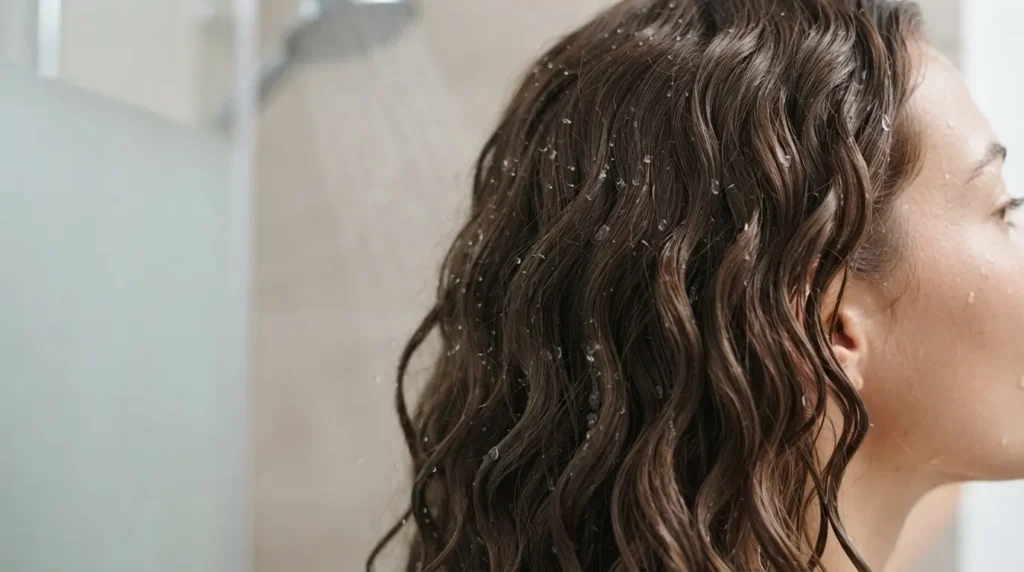
There is no single home test that can perfectly determine hair porosity. Your everyday hair behavior is usually more useful than relying on one test.
Common Characteristics
Possible signs include:
- Hair takes time to become fully wet
- Water tends to sit on the surface initially
- Products can seem to sit on the hair
- Styling products may accumulate quickly
- Hair takes a long time to dry
- Roots can become oily while lengths feel dry
- Heavy conditioners make waves lose volume
- Clarifying improves definition and movement
These characteristics are clues, not a diagnosis.
How Long Low Porosity Hair Takes to Get Wet
One common clue is that the hair does not become fully saturated immediately.
When showering, you may need to spend more time allowing water to reach the entire hair rather than quickly applying shampoo or conditioner.
For 2C hair, dense waves can make this even more noticeable because the wave pattern can prevent water from reaching every section immediately.
Practical example: If the outside of your hair feels wet after a few seconds but the middle layers still feel relatively dry, separate the hair gently with your fingers and allow water to reach the underneath sections.
How Long It Takes to Dry
Drying time can also provide useful information, although it is affected by many factors.
Hair density, length, weather, humidity, product quantity, and drying method all influence drying time.
Low porosity hair may take longer to become saturated but can also take considerable time to dry when a lot of water or product is present.
If your hair takes an unusually long time to dry after applying several layers of styling products, reducing product quantity may help.
Why the Water Test Is Not Always Reliable
The popular water test involves placing a strand of clean hair into water and observing whether it floats or sinks.
It can be tempting to treat this as a definitive answer, but hair oils, residue, strand thickness, surface tension, and other factors can affect what happens.
The same applies to slide tests and towel-dry observations. They can provide clues, but your actual wash-day behavior is more useful.
Common Problems With Low Porosity 2C Hair
Low porosity 2C hair can look healthy and shiny while still experiencing styling and moisture problems.
The most common issue is not necessarily a lack of products. In many cases, the problem is too much product sitting on the hair.
Product Buildup
Product buildup occurs when styling products, oils, conditioners, and other residues accumulate on the hair or scalp.
Low porosity hair may be particularly frustrating when buildup develops because additional products can make the hair feel even less manageable.
Signs may include:
- Hair suddenly feels coated
- Waves stop clumping
- Hair becomes dull
- Roots look greasy
- Styling products stop working as expected
- Hair feels heavy despite being freshly washed
Practical example: If your normal amount of gel suddenly leaves your waves flat, do not immediately add another product. Your hair may simply need a thorough cleanse.
Dry Ends and Oily Roots
Oily roots with dry ends can happen when the scalp produces oil while the lengths receive less natural lubrication.
Adding heavy oil to the ends may make the roots look greasy if the product spreads upward.
Instead, use a small amount of lightweight conditioning product where needed and keep your scalp cleansing routine consistent.
Flat or Weighed-Down Waves
2C waves can lose their bounce when too much product is used.
Heavy oils, thick butters, and excessive curl cream can reduce movement.
Fine 2C hair is especially likely to lose volume from excessive layering.
Practical example: If your waves look excellent immediately after styling but become flat once dry, try reducing your leave-in and curl cream amounts rather than changing your entire routine.
Frizz and Poor Moisture Balance
Frizz does not automatically mean your hair needs more oil.
Frizz can result from humidity, friction, damaged areas, insufficient conditioning, styling technique, or disrupted wave clumps.
A better approach is to identify the cause before adding more products.
Low Porosity 2C Hair Care Routine
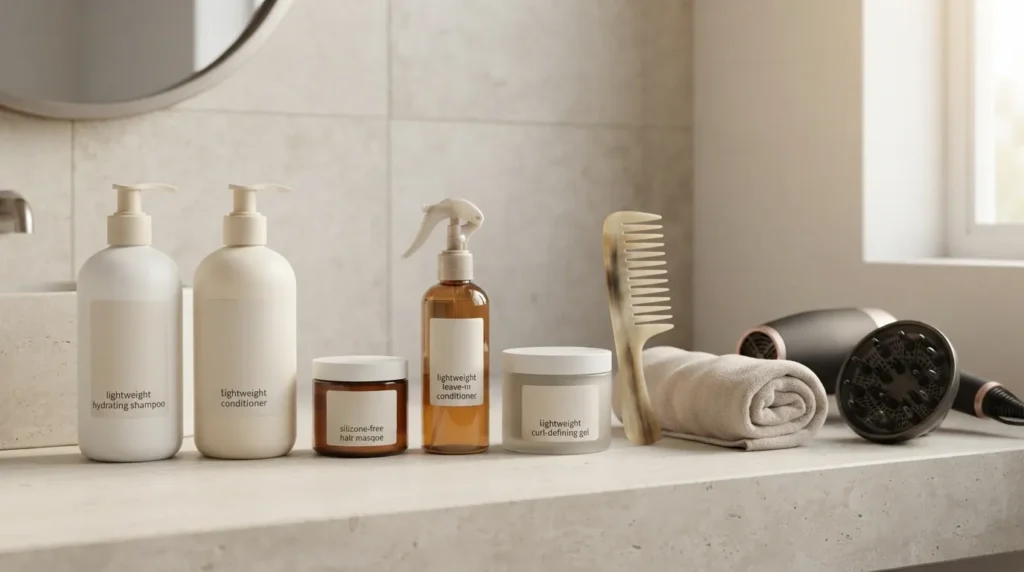
A simple low porosity hair routine can work better than a complicated routine containing many layers.
The following sequence gives you a practical starting point.
Step 1: Wash Your Scalp Properly
Start by thoroughly wetting the hair.
Use a gentle shampoo when your scalp and hair need regular cleansing. Concentrate shampoo primarily on the scalp and allow the lather to travel through the lengths rather than aggressively rubbing the ends.
If you have significant scalp buildup, occasional clarifying may be more appropriate.
The correct washing frequency depends on your scalp, activity level, styling habits, and oil production.
Step 2: Use a Lightweight Conditioner
After shampooing, apply conditioner mainly through the mid-lengths and ends.
Avoid automatically applying a large amount. Low porosity 2C hair often benefits from enough conditioner to provide slip without leaving a heavy coating.
Let the conditioner sit for a few minutes before rinsing.
Practical example: Start with a small amount. If the hair still feels rough while rinsing, add a little more rather than beginning with a large amount.
Step 3: Deep Condition With Gentle Heat
Deep conditioning can be useful when your hair needs additional softness.
For low porosity hair, gentle warmth may help make conditioning sessions feel more effective because warmth can soften the hair and improve the conditioning process.
This does not mean using excessive heat.
A warm towel or comfortably warm environment can be sufficient. Avoid making the scalp uncomfortably hot.
Step 4: Apply Lightweight Leave-In
After rinsing, use a lightweight leave-in conditioner if your hair needs it.
You may not need leave-in every wash day.
Fine 2C hair can sometimes get better definition from using a small amount of leave-in followed by gel rather than several rich products.
Step 5: Define With Curl Cream or Gel
Curl cream can provide softness and help encourage wave clumps, while gel can provide stronger hold and frizz control.
If your hair becomes flat easily, prioritize a lightweight gel and use curl cream sparingly.
Apply styling products while the hair is wet or very damp so the waves can group together naturally.
Step 6: Dry Without Disturbing the Waves
Avoid repeatedly touching the hair while it dries.
You can air-dry or use a diffuser on a suitable low or moderate setting.
A diffuser can help speed drying and support wave definition when used carefully.
Once the hair is fully dry, gently scrunch if necessary to soften any temporary cast from the gel.
Step 7: Refresh Between Wash Days
You do not always need to completely restyle your hair.
Lightly mist the waves with water and reshape sections with your hands.
If additional product is required, use a very small amount.
Practical example: If second-day waves look slightly flattened but are not frizzy, water alone may be enough. Adding another layer of cream could unnecessarily weigh them down.
How Often Should You Wash and Clarify 2C Hair?
There is no universal number of wash days that works for every person.
Your scalp is the best guide.
If your roots become oily quickly, you may need to wash more frequently. If your scalp remains comfortable for longer, you may be able to extend the time between washes.
When to Use a Gentle Shampoo
Use a gentle shampoo for routine cleansing.
The goal is to remove sweat, oil, dirt, and normal styling residue without leaving the hair unnecessarily stripped.
If your scalp feels comfortable and clean after washing, your cleanser is probably doing its basic job.
When to Clarify
A clarifying shampoo is designed to provide a deeper cleanse than a regular gentle shampoo.
Consider clarifying when you notice:
- Persistent product buildup
- Hair feeling coated
- Waves losing definition
- Excessive greasiness
- Styling products no longer performing normally
How Often to Clarify Low Porosity Hair
Clarifying should be based on buildup rather than an arbitrary schedule.
Some people may need it occasionally, while others may need it more often because they use multiple styling products.
Practical example: If your waves become dull and heavy after several styling sessions but return to normal after a deeper wash, that is a useful sign that buildup management should be part of your routine.
Best Products and Ingredients for Low Porosity 2C Hair
The best products are not necessarily the most expensive or the richest.
For many people with low porosity 2C waves, lightweight formulas are easier to balance.
Lightweight Shampoos and Conditioners
Look for formulas that cleanse effectively without leaving excessive residue.
A moisturizing shampoo can be useful if your hair feels dry, but excessive conditioning ingredients may not be necessary for every wash.
Conditioner should provide softness and slip without making your waves limp.
Leave-In Conditioners
A lightweight leave-in can help with softness and detangling.
Apply a small amount first. You can always add more if needed.
For fine hair, using too much leave-in is one of the easiest ways to lose volume.
Curl Creams and Gels
Curl creams generally focus on softness, conditioning, and wave or curl definition.
Gels tend to provide more hold.
For 2C waves, gel can be particularly useful when your priority is keeping S-shaped waves defined throughout the day.
Lightweight Oils
Lightweight oils can help reduce roughness and add shine when used sparingly.
Common options include:
- Argan oil
- Jojoba oil
- Almond oil
The key is quantity.
Oil is highly concentrated, so a few drops may be enough.
Helpful Ingredients
Depending on the formula and your individual hair, useful ingredients may include:
- Glycerin
- Hyaluronic acid
- Lightweight conditioning agents
- Humectants
- Lightweight emollients
Humectants can help attract water, although their performance can vary depending on the surrounding humidity and the rest of the formulation.
Ingredients and Products to Limit
You do not necessarily need to permanently ban specific ingredients.
Instead, pay attention to how your hair responds.
Products that may be too heavy for some low porosity 2C hair include:
- Very thick butters
- Heavy oils
- Large amounts of shea butter
- Very rich styling creams
- Excessive coconut oil
- Multiple layers of leave-in and cream
Practical example: If a product contains shea butter and makes your hair soft without reducing volume, it may work for you. If the same ingredient consistently creates greasy, flat waves, choose a lighter formula.
How to Moisturize Low Porosity 2C Hair Without Buildup
One of the biggest misconceptions about low porosity hair is that dryness should always be treated with more product.
Sometimes the hair feels dry because buildup is preventing your next conditioning treatment from performing well.
Moisture vs. Product Buildup
Healthy-looking hair requires balance.
If your hair feels dry and coated at the same time, adding more products may make the problem worse.
Instead:
- Cleanse when buildup is present.
- Condition with an appropriate amount.
- Use lightweight styling products.
- Avoid unnecessary layers.
- Monitor how your waves respond.
How Warm Water and Gentle Heat Can Help
Warm water can make the cleansing and conditioning process more comfortable and may help products distribute through the hair.
For deep conditioning, gentle warmth can be useful.
You do not need high heat to care for low porosity hair.
The objective is comfortable warmth, not overheating.
How to Prevent Weighed-Down Waves
Use the minimum amount of product that gives you the result you want.
This is particularly important for fine 2C hair.
Try applying styling products to soaking-wet hair, distributing them evenly, and then stopping rather than continuously adding layers.
What to Do About Dry Ends
If your ends feel dry, first check whether you are using enough conditioner and whether buildup is interfering with your routine.
Also consider friction from towels, sleeping surfaces, brushing, and frequent manipulation.
A small amount of lightweight leave-in or oil on the ends may help, but more product is not always better.
How to Define Low Porosity 2C Waves
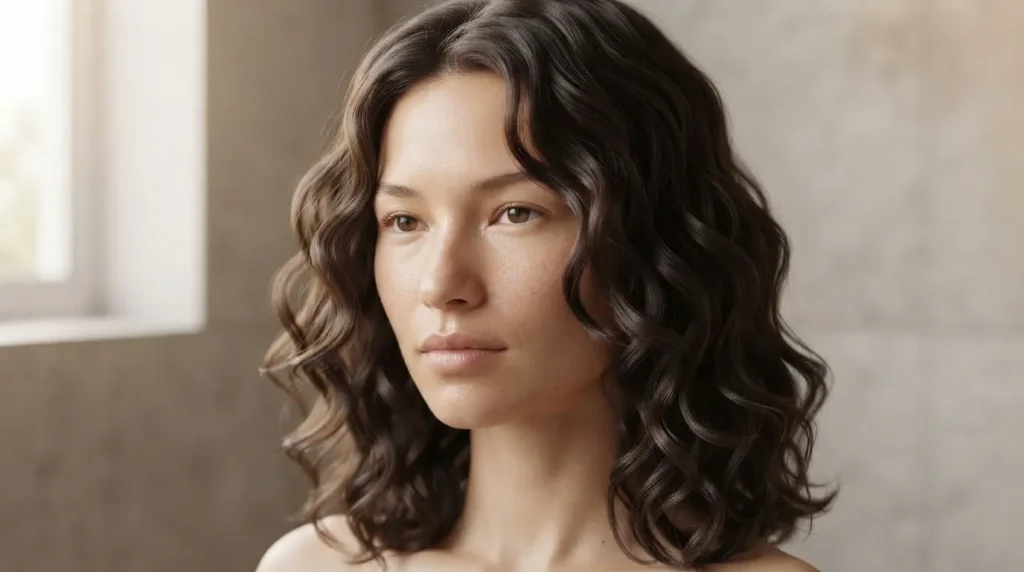
Good wave definition starts before the hair is dry.
Styling on Wet or Damp Hair
Water helps the waves group together.
Apply styling products while the hair is wet or very damp, then gently scrunch upward.
This can encourage natural wave clumps.
Creating Clumps
Instead of brushing the hair repeatedly after applying products, encourage sections to form their natural S-shaped pattern.
Gentle scrunching can help.
Avoid aggressively separating the clumps while the hair is drying.
Controlling Frizz
Frizz control is not about eliminating every individual hair.
Some natural flyaways are normal.
Focus on creating cohesive wave groups, using enough hold, and minimizing unnecessary touching while the hair dries.
Keeping Waves Bouncy
Bouncy waves usually require a balance between hold and weight.
If your waves are defined but flat, reduce heavy conditioning and styling layers.
If they are voluminous but frizzy, you may need better product distribution or stronger hold.
Practical example: If your waves have excellent shape but disappear within two hours, try increasing hold slightly with gel rather than adding more cream.
Protein and Low Porosity 2C Hair
Protein is often discussed in low porosity hair communities, but it should not automatically be treated as harmful.
Is Protein Always Bad?
No.
Protein-containing products can work well for some people.
The response depends on the hair’s condition, product formula, frequency of use, and individual sensitivity.
Understanding Protein Sensitivity
If your hair repeatedly feels unusually stiff, rough, or less flexible after using a particular protein-heavy product, you may prefer to reduce or avoid that product.
However, one negative experience does not necessarily mean every protein ingredient will cause the same result.
When to Choose Protein-Free Products
Protein-free products can be a useful option when you know your hair responds better to them.
Instead of following a universal rule, compare how your hair behaves before and after using a product.
Practical example: If your waves feel soft and flexible with a protein-free conditioner but become stiff with a particular protein-heavy formula, choose the conditioner that gives you the better result.
Practical Low Porosity 2C Hair Routine Examples
Different 2C hair types may require different versions of the same basic routine.
Fine 2C Hair With Oily Roots
A practical routine could be:
Wash: Gentle shampoo as needed
Condition: Lightweight conditioner on lengths
Style: Small amount of leave-in followed by gel
Dry: Air-dry or diffuse gently
Refresh: Water first, minimal product
The main goal is preventing heavy products from flattening the waves.
Worked example: If the roots look oily on day two but the ends look dry, do not automatically apply oil throughout the hair. Keep cleansing focused on the scalp and use conditioning only where the lengths need it.
Medium-Density 2C Hair With Dry Ends
This hair may tolerate slightly more conditioning.
A possible routine:
Wash: Gentle shampoo
Condition: Moderate amount through the lengths
Deep condition: Occasionally with gentle warmth
Style: Lightweight leave-in plus curl cream or gel
Finish: Tiny amount of oil on dry ends if needed
The priority is balancing moisture and definition.
Hair That Gets Buildup Quickly
If buildup is your main problem, simplify.
Use fewer styling products and clarify when your hair shows signs of residue.
A simple routine may outperform a seven-product routine.
Worked example: If your hair looks better immediately after clarifying, do not assume it needs a new curl cream. The improvement may simply mean your previous routine contained too much accumulated product.
Quick Reference Chart
| Goal | What to Try | What to Avoid |
|---|---|---|
| More moisture | Lightweight conditioner | Excessive layering |
| Less buildup | Regular cleansing + occasional clarifying | Constantly adding product |
| More definition | Gel on wet hair | Too much heavy cream |
| More volume | Lightweight styling | Heavy oils and butters |
| Softer hair | Conditioner or lightweight leave-in | Over-conditioning |
| Less frizz | Better clumping + hold | Repeated touching while drying |
| Dry ends | Targeted lightweight conditioning | Coating everything in oil |
| Oily roots | Appropriate scalp cleansing | Heavy products near roots |
| Deep conditioning | Gentle warmth | Excessive heat |
| Better refresh | Water + minimal product | Full restyling with many layers |
Frequently Asked Questions
Is 2C Hair Usually Low Porosity?
No. 2C describes the wave pattern, while porosity describes how the hair interacts with moisture.
A person can have 2C hair with low, medium, or higher porosity characteristics.
Hair porosity should therefore be considered separately from the wave type.
How Do I Know If My 2C Hair Is Low Porosity?
Look at several characteristics together.
Hair that takes longer to become fully wet, accumulates buildup easily, and becomes weighed down by rich products may have lower porosity characteristics.
However, no single home test can guarantee your porosity classification.
Why Does Low Porosity Hair Get Buildup?
When the hair’s surface does not readily absorb certain products, heavier ingredients can remain on the outside.
Repeated application without adequate cleansing can lead to buildup.
This is why lightweight products and appropriate cleansing are often useful for low porosity 2C hair.
Why Is My Low Porosity 2C Hair Dry?
Dryness can have several causes.
Your hair may need better conditioning, but buildup can also interfere with the feel of moisture. Environmental conditions, heat styling, friction, chemical processing, and excessive cleansing can also contribute.
Instead of immediately adding more products, examine your complete routine.
What Products Should I Avoid?
There is no universal banned-ingredient list.
If your hair becomes flat or coated easily, experiment with reducing very heavy oils, thick butters, rich creams, and excessive layers.
Coconut oil, shea butter, and other rich ingredients are not automatically bad; they may simply be too heavy for some individuals.
Does Heat Help Low Porosity Hair?
Gentle warmth can be useful during conditioning because it can make the conditioning process more comfortable and may help products work more effectively.
Avoid excessive heat.
You do not need very high temperatures to care for low porosity hair.
How Often Should I Clarify?
Clarify based on buildup rather than following a strict universal schedule.
If your hair feels coated, dull, heavy, or difficult to style, a clarifying wash may be appropriate.
If your hair remains clean and responsive, frequent clarification may not be necessary.
What Oil Is Best for Low Porosity 2C Hair?
There is no single best oil for everyone.
Lightweight options such as argan, jojoba, or almond oil may work well for some people.
Start with a very small amount and observe whether your hair remains soft and bouncy or becomes greasy and weighed down.
How Do I Keep Low Porosity 2C Hair Moisturized?
Focus on balance.
Use an appropriate cleanser, lightweight conditioner, and minimal styling layers. Deep condition when needed and consider gentle warmth during conditioning.
If your hair feels dry and coated at the same time, clarify before adding more products.
Is Protein Bad for Low Porosity Hair?
Not necessarily.
Some people with low porosity hair use protein products successfully, while others prefer protein-free formulas.
If your hair repeatedly becomes stiff or rough after a particular product, reduce its use and compare your results with a protein-free alternative.
Final Takeaway
The best low porosity 2C hair care routine is not about using the most products. It is about using the right amount of lightweight conditioning, cleansing buildup when necessary, and styling in a way that protects your natural S-shaped waves. Start simple, watch how your hair responds, and adjust one product or step at a time for softer, healthier, more defined, bouncy waves.
Read Next