
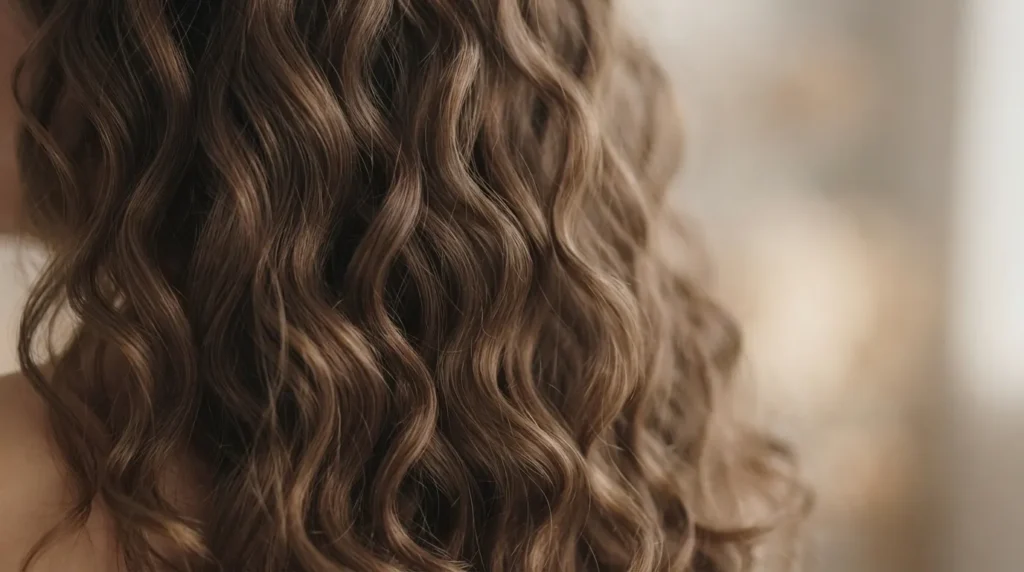
What Is 2C Hair?
2C hair is the waviest subtype in the Type 2 (wavy hair) category on the Andre Walker hair typing chart. It sits at the border between wavy and curly, forming defined S-shaped waves that start close to the root and often clump into loose curls by the mid-lengths and ends.
If you’ve ever wondered what type 2C hair actually means, the short answer is this: it’s thicker and more textured than 2A or 2B waves, with a wave pattern strong enough to hold shape without heat, but loose enough that it doesn’t coil like true curly hair.
People with 2C hair usually notice more volume and frizz than those with looser wave patterns, especially in humid weather. Recognizing this early makes it much easier to choose the right hair care routine and avoid products that weigh the waves down or strip them of moisture.
Understanding the Hair Typing System: 2A vs 2B vs 2C
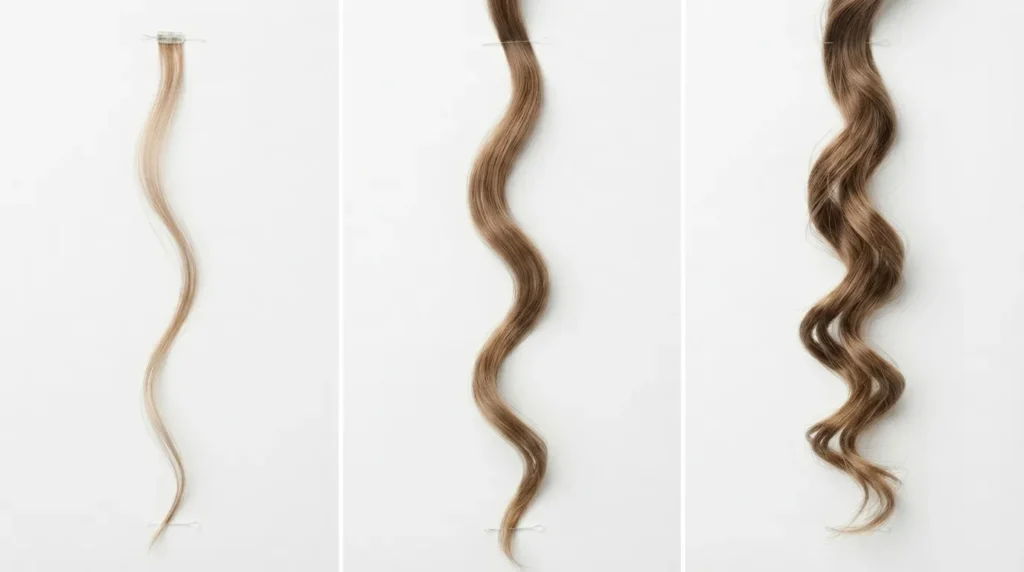
The Andre Walker system splits hair into four broad types — straight (1), wavy (2), curly (3), and coily (4) — with subtypes A, B, and C marking how tight the pattern gets within each type.
Within Type 2 hair, the difference between 2A, 2B, and 2C comes down to wave definition and where the wave pattern starts on the strand.
| Hair Type | Wave Pattern | Starts At | Texture Feel | Frizz Risk |
|---|---|---|---|---|
| 2A | Loose, barely-there S-waves | Mid-shaft | Fine, soft | Low |
| 2B | More defined S-waves | Closer to roots | Medium | Moderate |
| 2C | Strong, well-defined S-waves, some curl clumping | Near the root | Medium to coarse | High |
A simple way to picture it: 2A hair looks like beach waves after a swim, 2B hair looks like waves styled with a curling wand, and 2C hair looks like natural waves that already curl into loose ringlets on their own — plus a tendency toward flyaways and frizz if it isn’t moisturized properly.
Characteristics of 2C Hair
2C hair has a few defining traits that separate it from other wave and curl patterns:
- Wave pattern: Well-defined S-shaped waves that begin at or near the root, with some sections forming loose curls.
- Density: Usually medium to thick, meaning more strands per square inch than 2A or 2B hair.
- Texture: Strands can range from fine to coarse, though medium-coarse is most common.
- Volume: Naturally voluminous, especially at the crown, which can make root volume feel uneven compared to the ends.
- Frizz tendency: Higher than looser wave types because the wave pattern makes it easier for moisture in the air to disrupt the cuticle.
- Curl clumping: Strands naturally group together into wave “clumps,” which is part of what gives 2C hair its texture and shape.
2C Hair Porosity: Low, Medium, or High?
Porosity — how well hair absorbs and holds moisture — varies from person to person and isn’t determined by wave pattern alone, but it plays a huge role in how 2C hair behaves.
- Low porosity 2C hair has a tightly closed cuticle, so products tend to sit on top of the strand and cause buildup rather than absorbing.
- Medium porosity 2C hair absorbs and retains moisture fairly evenly, which usually means fewer styling struggles.
- High porosity 2C hair absorbs moisture quickly but loses it just as fast, leading to dryness, frizz, and rougher texture.
A quick way to check: drop a clean strand of hair into a glass of water. If it floats, porosity is likely low; if it sinks quickly, porosity is likely high.
How to Identify 2C Hair
Not sure if you actually have 2C hair? Try this simple identification method:
- Wash and air dry your hair with no product, so you can see your natural wave pattern.
- Look at the root area. If waves start almost immediately at the scalp rather than mid-strand, that points to 2C rather than 2A or 2B.
- Check the shape. 2C strands form a distinct “S” and often clump into loose spiral curls by the ends.
- Assess volume and frizz. 2C hair tends to look fuller and frizzier than looser wave types when left to dry on its own.
If your hair does all four, you’re very likely working with a 2C texture — possibly blended with some 3A curls, which is common and completely normal.
Is 2C Hair Curly or Wavy?
2C hair is technically classified as wavy, but it’s the closest wave pattern to curly hair on the typing chart. Many people with 2C strands have some curlier pieces mixed in, especially around the face or underneath layers.
This overlap is why 2C is often described as a “transitional” texture. It behaves like wavy hair in that it can fall relatively flat without styling help, but it also clumps and coils more than typical wavy hair once product and technique are added.
2C Hair vs 3A Hair: What’s the Difference?
The line between 2C and 3A hair is where most misclassification happens, since both types can display similar clumping.
| Feature | 2C Hair | 3A Hair |
|---|---|---|
| Curl shape | Loose S-waves, some curl | Well-defined loose curls (ringlets) |
| Curl diameter | Wide, loose | Sidewalk-chalk to wine-cork width |
| Root behavior | Waves near root, less curl | Curls typically start closer to root |
| Shrinkage | Minimal | Moderate |
| Best styling approach | Enhance waves without over-defining | Encourage full curl clumps |
If your hair curls around a finger easily and holds that shape after drying, you’re likely closer to 3A. If it forms a looser “S” that relaxes without hold, you’re in 2C territory.
Common Problems With 2C Hair
2C hair looks great when it’s healthy, but a few recurring issues show up if the routine isn’t dialed in.
Frizz. Because 2C strands have a slightly raised cuticle layer, humidity and friction easily disrupt the wave pattern, leading to frizz and flyaways — particularly around the hairline and crown.
Dryness. The wave pattern makes it harder for natural scalp oils to travel down the length of the hair compared to straight hair, which often leaves the mid-lengths and ends dry and prone to breakage.
Product buildup. Heavy creams, silicones, and leftover styling products can coat 2C strands and weigh the waves down, especially for those with low porosity hair.
Flat roots, frizzy ends. A common complaint is limp volume at the scalp paired with frizzy texture everywhere else — usually a sign the routine needs more root-lifting technique and better moisture-to-hold balance.
Example scenario: Someone with medium-porosity 2C hair who skips deep conditioning and uses a sulfate-heavy shampoo weekly will likely notice dull, frizzy strands with poor curl clumping — a pattern that usually reverses within a few weeks of switching to sulfate-free, moisture-focused products.
Best Hair Care Routine for 2C Hair
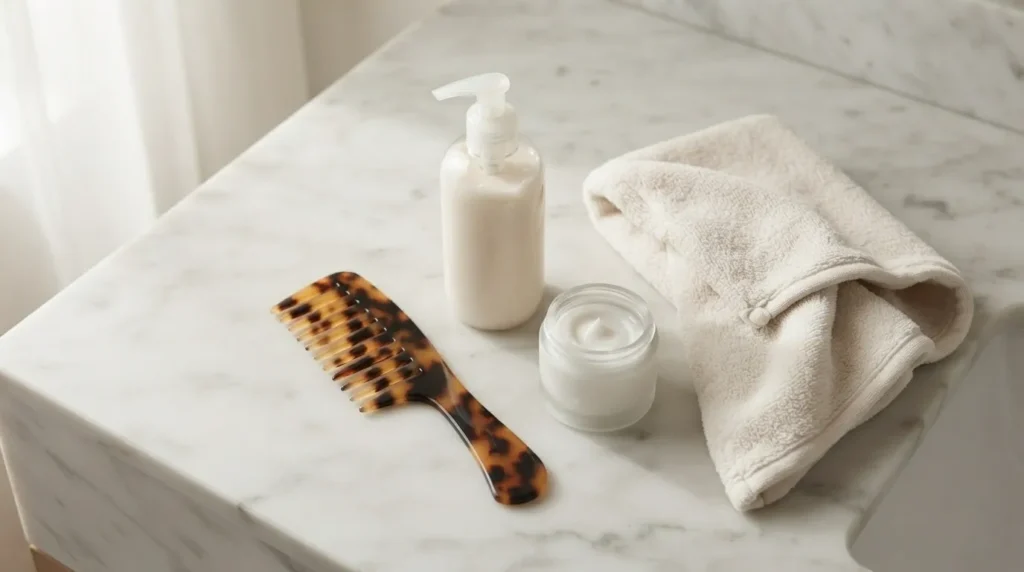
A solid 2C hair care routine is built around gentle cleansing, consistent hydration, and lightweight hold — not heavy products that flatten the wave pattern.
How Often Should You Wash 2C Hair?
Most 2C hair does best on a wash schedule of every 2–4 days. Washing too often strips natural oils and increases dryness; waiting too long allows product buildup and can flatten root volume. Co-washing (conditioner-only washing) between full shampoo days can help maintain moisture without over-cleansing.
Best Shampoo and Conditioner
A sulfate-free shampoo is generally best for 2C hair, since sulfates can strip moisture and disrupt the wave pattern. Pair it with a silicone-free conditioner so the hair doesn’t build up residue that leads to limp, weighed-down waves. A clarifying shampoo used every few weeks helps remove product buildup without over-drying hair in between.
Leave-In Conditioner, Curl Cream, Mousse, and Gel
| Product | Purpose | Best For |
|---|---|---|
| Leave-in conditioner | Adds moisture, detangles, preps hair for styling | All porosity types |
| Curl cream | Defines waves, reduces frizz, adds light hold | Medium to high porosity |
| Mousse | Adds volume and light hold without weight | Fine to medium density |
| Gel | Locks in wave definition, controls frizz | Medium to thick density |
| Hair oil | Seals in moisture, adds shine | Low porosity (light oils), high porosity (heavier oils) |
Layering a leave-in conditioner, then a curl cream, then a light gel — known as the “LCG” method — is one of the most reliable ways to build wave definition without stiffness.
Best Oils and Ingredients to Look For
Look for humectants like glycerin and aloe vera to draw in moisture, along with lightweight oils such as argan or grapeseed oil for shine without buildup. Avoid heavy silicones and mineral oil-based products if your hair leans low porosity, since these ingredients are harder to wash out and tend to flatten wave definition over time.
How to Style 2C Hair for Defined Waves

Styling 2C hair well comes down to technique as much as product choice.
Detangling first. Always detangle wet hair with a wide-tooth comb or your fingers (finger combing), starting at the ends and working up, ideally with conditioner still in the hair to reduce breakage.
Air drying. Apply styling products to soaking-wet hair, scrunch upward toward the scalp to encourage clumping, then let hair air dry undisturbed for the most natural wave definition.
Diffusing. For faster drying with more volume, use a diffuser attachment on low heat and low speed, cupping sections of hair and lifting toward the scalp rather than rubbing, which causes frizz.
Plopping and micro plopping. Plopping — wrapping soaking-wet, product-coated hair in a T-shirt or microfiber towel — helps set the wave pattern while reducing drying time and frizz. Micro plopping (plopping in small sections for 5–10 minutes) works well for finer 2C strands that need extra root lift.
Refreshing curls. On non-wash days, mist hair lightly with water or a diluted leave-in spray, then scrunch gently to reactivate the wave pattern without full restyling.
Example scenario: A person with fine, low-porosity 2C hair gets better results micro plopping for 5 minutes and diffusing on low heat than full plopping for 20 minutes, which tends to leave fine strands overly damp and prone to frizz once unwrapped.
Nighttime Routine for 2C Hair
Protecting waves overnight prevents frizz and preserves styling effort from wash day.
- Switch cotton pillowcases for a silk pillowcase or sleep in a satin bonnet to reduce friction.
- Use the pineapple method — gathering hair loosely on top of the head with a scrunchie — to protect wave shape while sleeping.
- Avoid tight ponytails or buns overnight, which can create creases or flat spots in the wave pattern.
Best Hairstyles for 2C Hair
2C hair adapts well to a range of lengths and styles, though maintenance needs shift depending on how short or long it is.
Short hairstyles for 2C hair: A wavy bob or textured pixie cut works well, since shorter lengths reduce the weight that can pull waves straight, allowing more natural volume and definition.
Medium hairstyles for 2C hair: Shoulder-length layered cuts help distribute wave pattern evenly and are easy to maintain with a simple wash-and-go routine.
Long hairstyles for 2C hair: Longer 2C hair often benefits from face-framing layers to prevent bottom-heavy, weighed-down ends, plus protective hairstyles like loose braids to reduce daily manipulation and breakage.
Mistakes to Avoid With 2C Hair
- Over-brushing dry hair, which breaks up clumps and creates frizz instead of smooth waves.
- Using heavy, silicone-rich products that build up and flatten volume over time.
- Skipping deep conditioning, which leaves strands dry, brittle, and prone to split ends and breakage.
- Applying products to dry hair, which usually creates a crunchy or flaky look instead of soft definition.
- Ignoring regular trims, which allow split ends to travel up the hair shaft and damage healthy sections.
2C Hair Maintenance Tips for Long-Term Health
Beyond the wash-day routine, a few ongoing habits keep 2C hair looking its best month after month.
Trim regularly. Scheduling a trim every 8–12 weeks removes split ends before they travel up the shaft, which keeps waves looking uniform instead of scraggly at the tips.
Balance protein and moisture. 2C hair can swing between feeling limp (often a sign of too much protein) and feeling mushy or stretchy (often a sign of too much moisture). A monthly protein treatment, alternated with regular deep conditioning, helps keep elasticity in check.
Protect against buildup. Even lightweight products accumulate over time, especially on low porosity strands. A clarifying wash every 2–3 weeks resets the hair so leave-ins and creams can actually absorb instead of sitting on the surface.
Manage scalp health. Since 2C hair often goes several days between washes, scalp care matters just as much as strand care. A lightweight scalp oil or occasional scalp scrub helps prevent product buildup and supports healthier hair growth from the root.
Example scenario: Someone whose 2C waves feel consistently limp and lifeless despite regular deep conditioning may actually be dealing with protein overload rather than dryness — switching to a protein-free routine for a few weeks often restores bounce and curl clumping.
Can You Brush or Straighten 2C Hair? Can the Pattern Change?
Can you brush 2C hair? Brushing dry 2C hair generally isn’t recommended, since it breaks apart the natural wave clumps and increases frizz. Detangling wet hair with a wide-tooth comb or fingers is a gentler alternative.
Can you straighten 2C hair? Yes, though frequent heat styling causes heat damage and can gradually loosen or damage the natural wave pattern over time. Using a heat protectant and limiting straightening to occasional use helps preserve curl and wave elasticity.
Can 2C hair become curly, or lose its pattern? Wave and curl patterns can shift due to hormonal changes, chemical treatments, heat damage, or simply healthier hair care habits — many people notice more defined curls once they switch to a moisture-focused routine. Conversely, heat damage, harsh products, or excessive manipulation can cause 2C hair to lose definition and appear straighter or frizzier over time.
Frequently Asked Questions About 2C Hair
What is 2C hair?
2C hair is a wavy hair type characterized by defined S-shaped waves that start near the root and often clump into loose curls, with more volume and frizz potential than looser wave types.
Is 2C hair curly or wavy? It’s classified as wavy, but it’s the most curl-like of the wave subtypes and often includes some curlier pieces mixed throughout.
How do I know if I have 2C hair?
Air dry your hair without product and check whether your waves start near the root, form a clear “S” shape, and clump into loose curls by the ends — if so, you likely have 2C hair.
How often should I wash 2C hair?
Every 2–4 days works for most people, with co-washing as an option in between to maintain moisture without over-cleansing.
What’s the best routine for 2C hair?
A sulfate-free shampoo, silicone-free conditioner, leave-in conditioner, curl cream, and light gel applied to soaking-wet hair, followed by air drying, diffusing, or plopping.
Can 2C hair be damaged by heat styling?
Yes — frequent heat exposure without protection can weaken the wave pattern and lead to dryness, breakage, and reduced curl definition over time.
Conclusion
2C hair sits right at the edge of wavy and curly, which is exactly what makes it rewarding once you understand it. The right routine — gentle cleansing, real hydration, and techniques like plopping or diffusing — turns frizz-prone strands into defined, bouncy waves. Learn your hair’s specific porosity and density, adjust products accordingly, and consistency will do the rest.
Read Next.
Pingback: 2C and 3A Hair: Your Complete Curl Care Guide
Pingback: 2C and 3A Hair Mix: Identify & Style Guide