
Table of Contents
2C Hair With Bangs Styles, Cuts & Care Guide
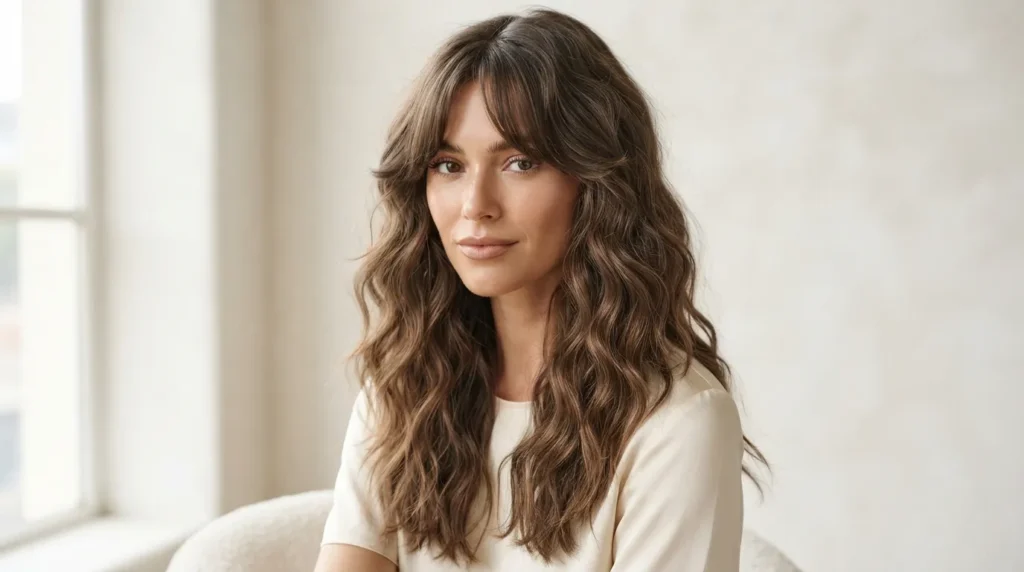
Adding bangs to naturally textured hair can completely change the shape of a hairstyle. 2C hair with bangs is especially versatile because strong waves, loose curls, and natural volume can create movement around the face without requiring a perfectly polished finish.
Type 2C hair usually has stronger S-shaped waves than other wavy hair types. Some sections may also form loose curls, particularly around the front and underneath layers. This combination gives the hair plenty of texture, but it also means that bangs need to be cut and styled with the natural pattern in mind.
The right bangs can make 2C wavy hair look more intentional while complementing its natural movement. Curtain bangs, curly bangs, face-framing pieces, and layered styles are all options worth considering.
The biggest mistake is choosing a bang style based only on how it looks on straight hair. Your natural hair texture, density, shrinkage, and styling routine all affect the finished result.
This guide explains how different bangs work with 2C hair, how to choose a haircut, how to style your fringe, and how to maintain the shape as your hair grows.
What Does 2C Hair Look Like With Bangs?
2C hair sits toward the curlier end of the wavy category. Instead of forming only loose bends, it commonly creates pronounced S-shaped waves and may develop individual curls throughout the hairstyle.
When bangs are added, these shorter pieces can show even more texture because they have less weight pulling them downward.
That can be a major advantage. A long hairstyle may sometimes hide the natural movement of your hair, while shorter pieces around the forehead can make the wave pattern more noticeable.
For example, imagine someone with shoulder-length 2C wavy hair. Without bangs, most of the movement may begin around the cheekbones. Adding longer curtain bangs can move some of that texture closer to the eyes and create a more face-framing shape.
However, 2C hair does not always behave consistently across the entire head. One side may wave differently from the other, and the front may have more or less shrinkage than the back.
That natural variation should be considered before choosing a precise bang length.
What makes 2C hair different?
Common characteristics of 2C hair include:
- Defined S-shaped waves
- Occasional loose curls
- Moderate to high natural volume
- Noticeable hair texture
- Potential curl shrinkage
- Frizz when the hair is over-handled
- Different wave patterns throughout the head
Not every person with 2C hair will have exactly the same characteristics. Hair density, porosity, length, and styling habits can all change the final appearance.
Practical example: If your hair looks wavy when wet but develops much stronger bends as it dries, your stylist should consider the dry shape when planning your bangs.
Best Bangs for 2C Hair
There are several bang styles that can complement 2C hair. The best choice depends on whether you want something subtle, dramatic, easy to grow out, or strongly connected to your natural curl pattern.
Curtain Bangs
Curtain bangs are among the most adaptable choices for 2C hair.
They are typically shorter near the center and gradually become longer toward the sides. This creates a soft transition between the bangs and the rest of the hairstyle.
For textured hair, the transition can be especially attractive because natural waves add movement to the graduated shape.
Longer curtain bangs are also relatively forgiving when they grow out.
Curly Bangs
Curly bangs allow your natural curls and waves to remain visible rather than being stretched or straightened.
If your 2C hair contains a few sections that resemble 3A curls, the front may naturally become more defined than the rest of the hairstyle.
Curly bangs can emphasize this difference and create a textured fringe.
The important thing is to avoid expecting every curl to have identical shape or length.
Face-Framing Bangs
Face-framing bangs are a good option if you want shorter pieces around the face without committing to a traditional straight-across fringe.
These pieces can gradually blend into face-framing layers.
They work particularly well with layered 2C hair because the shorter sections can connect naturally with the layers on the sides.
Short Bangs
Short bangs create a stronger visual change.
They can work with 2C hair, but they require more consideration because wave pattern and curl shrinkage can make them appear shorter after drying.
Someone who wants a low-maintenance haircut may prefer longer bangs.
Someone who enjoys styling their natural texture may be comfortable with a shorter curly fringe.
2C Hair With Curtain Bangs
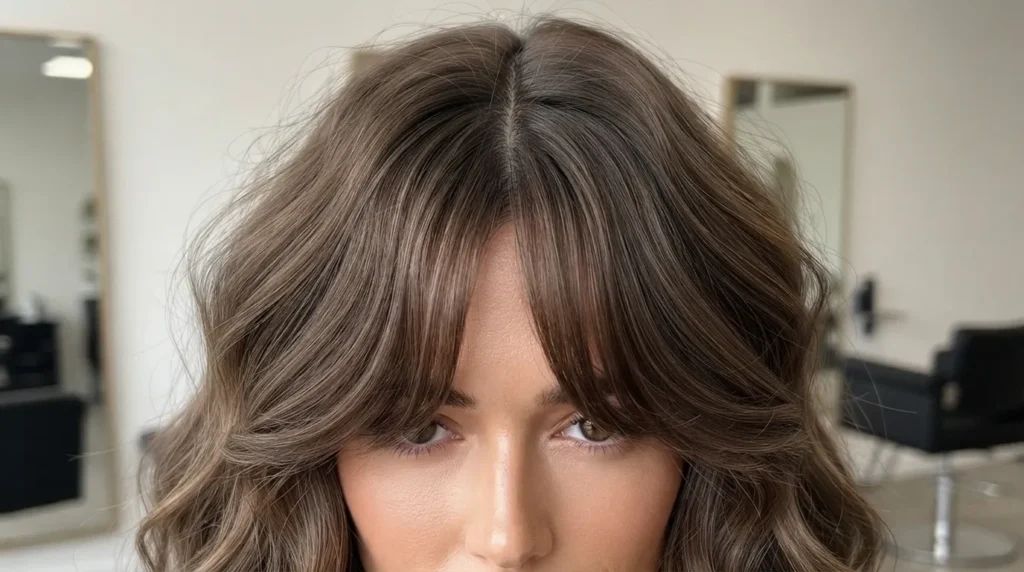
2C hair with curtain bangs is a particularly flexible combination because the natural movement of wavy-curly hair works well with the open shape of curtain bangs.
Rather than creating a solid horizontal line across the forehead, curtain bangs usually separate around the center and flow toward the sides.
This makes them easier to blend into medium or long hairstyles.
Why Curtain Bangs Work With 2C Waves
2C waves already provide natural movement.
Curtain bangs add another layer of movement without requiring the entire hairstyle to be heavily styled.
The longer sides can merge into the surrounding hair, while the shorter center sections create definition around the forehead.
For example, someone with thick 2C hair could combine long curtain bangs with several longer layers. The bangs would create shape at the front while the layers distribute volume through the rest of the hairstyle.
How Long Should 2C Curtain Bangs Be?
The ideal length depends on your natural texture.
A section that looks long when stretched may appear considerably shorter once it returns to its natural wave pattern.
If you are unsure, discuss your preferred dry length with a stylist who understands textured hair.
Longer curtain bangs generally offer more flexibility. They can be moved to either side, blended into the rest of the hair, or allowed to grow longer without immediately looking out of place.
Middle-Part Curtain Bangs
A middle part is a natural match for curtain bangs.
The part creates an opening through which the bangs can fall toward both sides of the face.
However, you do not need to force a perfectly centered part if your natural hair prefers another direction.
Working with your natural part can reduce daily styling and make your bangs easier to manage.
Short 2C Curly Hair With Bangs
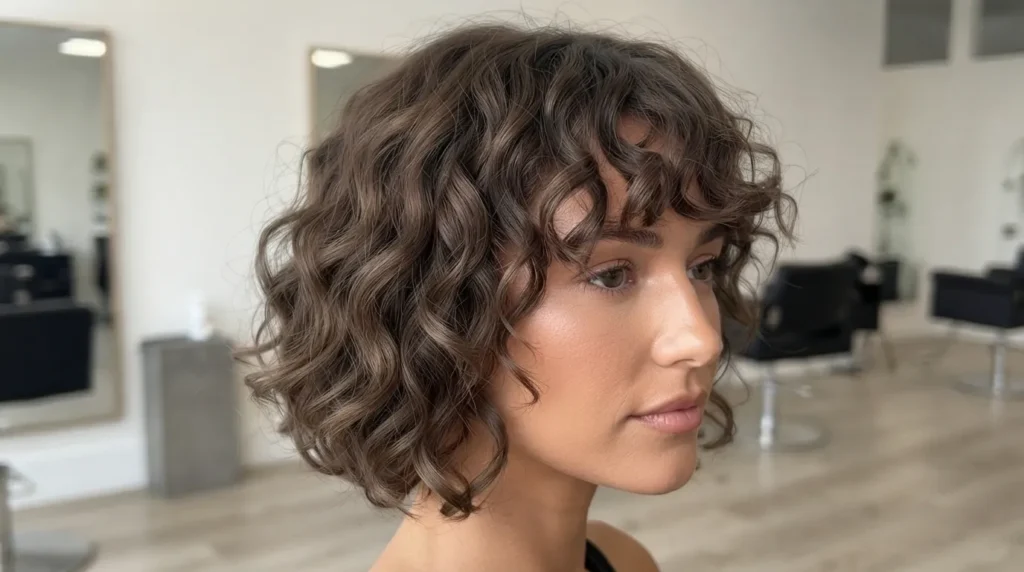
Shorter hairstyles can make 2C hair appear fuller because there is less length weighing down the waves.
Short 2C curly hair with bangs can take several forms, including a curly bob, chin-length cut, or short layered hairstyle.
The key is controlling the shape rather than simply removing length.
Short Curly Bob With Bangs
A curly bob can create a compact shape around the face while allowing natural waves to provide texture.
Adding bangs can make the haircut feel more connected and intentional.
For medium-density hair, a softly layered bob can maintain movement without creating excessive bulk.
For very dense hair, the shape may need more careful internal layering.
Chin-Length Bob
A chin-length bob can highlight the jawline while keeping the natural waves visible.
Because 2C hair can shrink as it dries, the actual dry length may sit higher than expected.
A stylist can account for this when shaping the cut.
If you want a chin-length result, show your stylist how you want the finished dry hairstyle to look rather than relying only on a measurement taken from wet hair.
Short Layered 2C Hair
Layers can give short 2C hair additional movement.
A layered haircut can also help connect the bangs with the sides of the hairstyle.
The goal is not necessarily to create as many layers as possible. Too much short layering can sometimes create more volume than you want.
Practical example: If your hair is very dense and expands significantly after drying, a stylist may use strategic layers to create shape while keeping the overall silhouette balanced.
Best 2C Hairstyles With Bangs
The best 2C hairstyles with bangs usually work with the natural texture instead of trying to make every wave identical.
Different cuts can create very different results.
Layered 2C Hair With Bangs
Layers are useful when you want movement throughout the hairstyle.
Longer layers can reduce the heavy appearance of one-length hair while maintaining enough weight for the waves to form.
When combined with bangs, the layers can create a gradual transition from the forehead to the sides and back.
This approach works well for medium and long hair.
2C Curly Shag With Bangs
A curly shag is a more textured option.
It typically relies on layers, volume, and a deliberately relaxed shape.
With 2C hair, natural waves can give the style plenty of movement without extensive styling.
A curly shag can also incorporate a curly fringe or longer bangs that blend into the surrounding layers.
This is a good choice for someone who prefers a less structured appearance.
Face-Framing Layers
Face-framing layers can make bangs easier to blend as they grow.
Instead of ending abruptly, the bangs gradually transition into longer pieces around the cheeks and jawline.
This can make the haircut more versatile because the front sections can be styled forward, parted, or pushed away from the face.
Curly Hairstyles With Bangs
There are many curly hairstyles that can accommodate bangs.
You could combine bangs with a bob, layered cut, shag, or medium-length textured hairstyle.
The common factor is that the haircut should account for the natural wave pattern.
Practical example: If you want volume at the crown but less bulk around the sides, your stylist can adjust the layering so that the final shape supports that preference.
How to Cut 2C Bangs Without Losing Their Shape
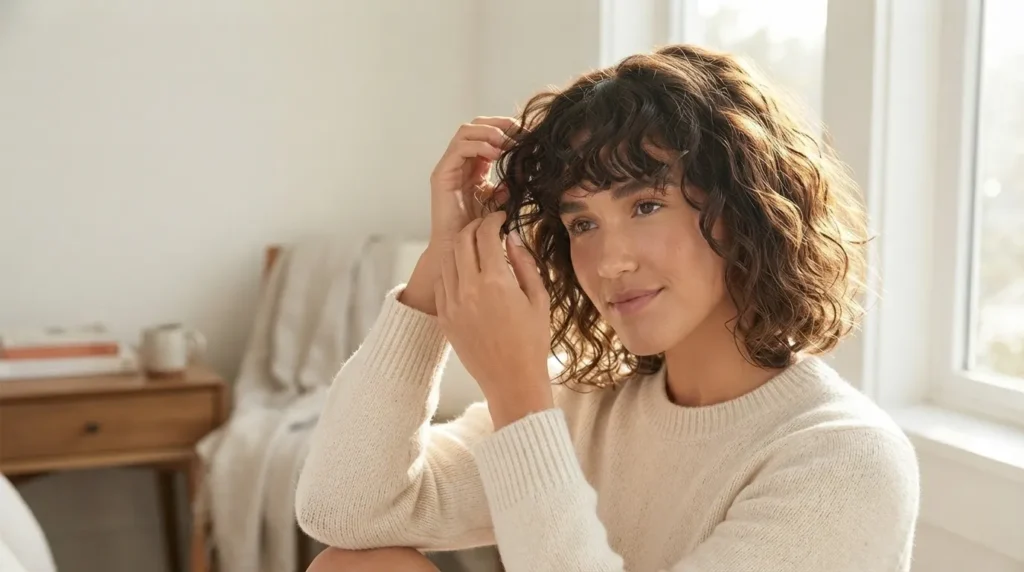
Bangs should not be treated exactly like straight hair.
The natural wave pattern can alter the apparent length and direction of each section.
Before cutting, consider:
- How your hair looks completely dry
- Where your natural part falls
- How much shrinkage you experience
- Whether your hair is fine, medium, or dense
- How often you want to style the bangs
- How the bangs will grow into the rest of the haircut
If you are inexperienced with textured haircuts, professional cutting is usually the better choice.
Should You Cut 2C Bangs Wet or Dry?
There is no single technique that applies to every person with 2C hair.
The important point is that the stylist needs to understand how your hair behaves in its natural state.
A dry haircut can make it easier to observe the existing wave pattern and how individual sections sit around the face.
Depending on the desired style, a professional may use different cutting techniques.
If you are doing a small DIY trim, avoid removing a large amount of length at once.
Understanding Curl Shrinkage
Curl shrinkage occurs when textured hair appears shorter in its natural state than when stretched.
This is especially relevant to bangs because a small difference in length can significantly change the appearance around your face.
For example, a piece that reaches the eyebrows when stretched may sit noticeably higher after the natural wave returns.
That is why you should never assume the stretched length is the final length.
How to Avoid Uneven Bangs
Uneven bangs can happen when individual waves spring up differently.
To reduce this risk, avoid making large cuts based on a single stretched section.
Instead, consider the natural pattern of each section.
If one side naturally curls more strongly, it may sit higher even when both sides are technically the same length.
A professional can adjust the shape to account for these differences.
How to Style 2C Bangs
Styling 2C bangs is mainly about encouraging natural definition while avoiding unnecessary manipulation.
Start with damp hair rather than soaking wet hair.
Apply a suitable amount of lightweight styling products and distribute them gently.
Then shape the bangs according to the direction you want them to dry.
Using Mousse, Curl Cream, and Styling Gel
Mousse is useful when you want lightweight volume and wave enhancement.
Curl cream can provide softness and moisture, although too much may weigh down fine hair.
Styling gel can add hold and help maintain definition while the hair dries.
You do not need to use all three products.
For example:
Fine 2C hair: A small amount of mousse followed by light-hold gel may be enough.
Thicker 2C hair: Curl cream followed by gel may provide better control.
The right routine depends on how your hair responds.
Air Drying vs. Using a Diffuser
Air drying is simple and requires no equipment.
However, it can take longer and may leave you tempted to touch the bangs while they are drying.
A diffuser can speed up drying while helping maintain the natural shape.
When using one, avoid aggressively moving the bangs around.
A simple routine could be:
- Wash and condition the hair.
- Gently remove excess water.
- Apply styling product.
- Arrange the bangs.
- Air dry or gently diffuse.
- Avoid excessive touching until completely dry.
How to Enhance Curl Definition
Curl definition comes from allowing natural wave clumps to form.
Instead of repeatedly brushing the hair, gently shape it while damp.
You can use your fingers to encourage sections into their natural direction.
Once the hair begins drying, avoid repeatedly separating those sections.
Practical example: If your bangs look defined immediately after styling but become fluffy later, try reducing how often you touch them during the drying stage.
How to Prevent Frizz in 2C Bangs
Frizz can be more noticeable around bangs because they sit close to the face and are often touched throughout the day.
One of the easiest ways to improve frizz control is to reduce unnecessary handling.
Other useful habits include:
- Apply styling products to damp hair.
- Avoid aggressive towel drying.
- Avoid excessive brushing after styling.
- Let the hair dry without repeatedly touching it.
- Use products appropriate for your hair density.
- Avoid applying too much heavy product to the roots.
- Give the wave pattern time to set.
Frizz is not necessarily a sign that your hair is unhealthy. Natural textured hair can have some variation and flyaways.
The goal is to create a manageable shape while preserving the natural texture.
How to Maintain 2C Curtain Bangs
Bangs can require more frequent attention than the rest of the haircut because even a small change in length can affect the shape around your face.
Short bangs usually need more maintenance than long curtain bangs.
Longer curtain bangs are more forgiving because they can gradually blend into the rest of the hair as they grow.
When washing your hair, pay attention to how much product reaches the roots.
If your bangs become flat easily, heavy amounts of product near the scalp may make the problem worse.
If your hair becomes dry or difficult to manage, focus on a balanced conditioning routine rather than simply adding more styling product.
Practical example: Someone who wants minimal maintenance might choose longer curtain bangs that can eventually become face-framing layers instead of selecting a short, precise fringe that requires frequent trimming.
2B vs 2C Hair With Bangs
2B and 2C hair are both wavy textures, but their natural patterns can behave differently when bangs are added.
| Feature | 2B Hair | 2C Hair |
|---|---|---|
| Wave pattern | Loose to defined waves | Strong S-shaped waves |
| Curl tendency | Mostly waves | May include loose curls |
| Volume | Moderate | Often more noticeable |
| Shrinkage | Usually less obvious | Can be more noticeable |
| Texture | Soft waves | Stronger texture |
| Bang movement | Loose and flowing | More pronounced |
| Styling needs | Often moderate | Can require more shaping |
| Suitable styles | Curtain and face-framing | Curtain, curly, layered, shag |
Someone with 2B hair may find that bangs maintain a relatively loose wave.
Someone with 2C hair may experience stronger bends and more visible shrinkage.
If your hair falls between 2B and 2C, you can still use many of the same haircut ideas.
The final choice should be based on your actual hair behavior rather than the label alone.
Quick Reference Guide for 2C Bangs
| Your goal | Style to consider | Maintenance |
|---|---|---|
| Easy grow-out | Long curtain bangs | Low |
| Face framing | Layered bangs | Low–medium |
| Natural texture | Curly bangs | Medium |
| Short hairstyle | Curly bob with bangs | Medium |
| Maximum texture | Curly shag | Medium |
| More movement | Layered 2C hair | Medium |
| Minimal daily styling | Longer bangs | Low |
| Strong definition | Bangs + suitable styling gel | Medium |
| Soft waves | Mousse + air drying | Low–medium |
This chart is only a starting point. Your natural density, wave pattern, and preferred styling routine should guide the final choice.
Common Mistakes to Avoid With 2C Bangs
Cutting Too Much at Once
This is one of the biggest risks with textured bangs.
Because of curl shrinkage, removing a small amount can sometimes create a much shorter result after drying.
Make gradual changes if you are maintaining your bangs yourself.
Ignoring Natural Hair Texture
Your hair may not behave the same way as a straight-haired reference photo.
The same haircut can look completely different depending on wave pattern and density.
Use hairstyle references that show natural textured hair when discussing your desired result with a stylist.
Using Too Much Product
More product does not automatically mean more definition.
Too much curl cream or gel can make bangs feel heavy or cause them to lose volume.
Start small and add more only when necessary.
Brushing Dry Bangs
Brushing can break up natural wave clumps and make the hair appear larger or frizzier.
If you prefer defined waves, do most of the shaping while the hair is damp.
Touching Bangs While They Dry
Constantly moving the hair can disrupt the forming wave pattern.
Once the bangs have been positioned, give them time to dry.
Choosing a Style You Cannot Maintain
A hairstyle should fit your daily routine.
If you rarely style your hair, an intricate bang shape may become frustrating.
Longer curtain bangs can be a more flexible option because they usually offer several styling possibilities.
Frequently Asked Questions About 2C Hair With Bangs
Are curtain bangs good for 2C hair?
Yes. Curtain bangs can complement 2C hair because their gradual shape works naturally with waves and curls.
Longer sides can blend into the rest of the hairstyle, making the grow-out process easier.
How long should 2C curtain bangs be?
There is no universal length.
Your natural wave pattern, shrinkage, density, and preferred appearance should determine the length.
If you are unsure, longer bangs are generally easier to adjust and grow out.
Can you wear short bangs with 2C curls?
Yes. Short bangs can work beautifully with natural texture.
However, they may require more maintenance because 2C waves can spring upward as they dry.
How do you style curly curtain bangs?
Apply a small amount of suitable styling product to damp hair, arrange the bangs according to their natural wave direction, and let them air dry or gently diffuse.
Avoid repeatedly touching them while they dry.
Do 2C bangs shrink when they dry?
They can.
The amount of shrinkage depends on the individual’s wave and curl pattern.
Always consider how your bangs look in their natural dry state before deciding on a short length.
How often should 2C bangs be trimmed?
It depends on the style.
Short, precise bangs generally need more frequent trimming, while longer curtain bangs can grow out for longer without losing their overall shape.
Are bangs for wavy hair different from bangs for curly hair?
They can be.
Wavy hair may have less shrinkage and a looser pattern, while curly hair can spring upward more strongly.
2C hair sits between these categories, so the haircut needs to account for its specific behavior.
Can 2C hair have uneven bangs?
Natural waves can make bangs appear uneven even when the cut itself is balanced.
Different sections may shrink differently.
That is why the natural dry pattern should be considered when shaping textured bangs.
Is a curly bob good for 2C hair?
A curly bob can work well with 2C texture.
The shorter length can allow the waves to become more visible, while carefully placed layers can help create a balanced shape.
Can 2C hair have a curly shag with bangs?
Yes. A curly shag can complement the natural movement of 2C hair.
Layers and a textured fringe can create a relaxed hairstyle with plenty of natural volume.
Conclusion
2C hair with bangs offers plenty of room for creativity without requiring you to hide your natural texture. Curtain bangs, curly fringe, face-framing layers, short bobs, and shag cuts can all work when they are shaped around your natural wave pattern.
The most important factors are your dry hair shape, curl shrinkage, density, and daily routine. Choose a cut that works with your natural waves, use lightweight styling products when appropriate, and give your bangs time to form their shape as they dry.
The best 2C bangs are not the ones that fight your texture—they are the ones that make your natural waves look intentional.
Read Next
Pingback: 2C Hairstyles for Men: Best Haircuts Guide