
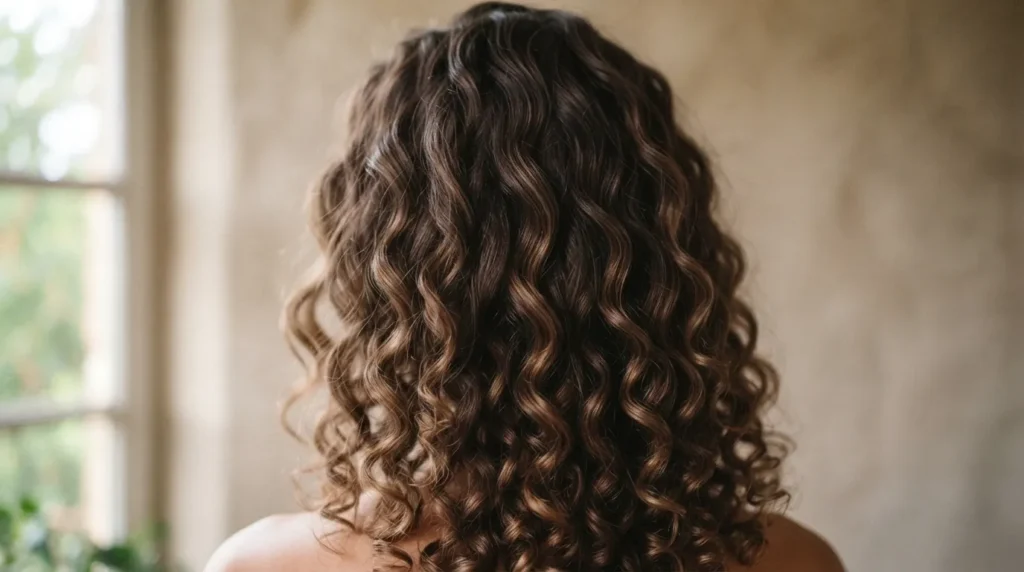
What Is a 2C and 3A Hair Mix?
A 2C and 3A hair mix means your head holds two curl patterns at once. Some sections fall into the 2C category — deep, defined waves that start to curl at the ends. Other sections cross into 3A territory — loose, springy curls with a clear S-shape from root to tip.
This isn’t unusual. Most curly and wavy heads aren’t a single, clean type. Hair type charts were built as reference points, not rigid boxes, and a 2c 3a hair mix is one of the most common combinations reported by people with medium-to-thick natural texture.
The mix usually shows up in predictable zones. Crown and top layers often run looser (2C), while the nape and sides curl tighter (3A) because of denser follicle placement and different gravity pull. Recognizing this pattern is the first step toward a routine that treats your whole head fairly instead of styling for only one texture.
How to Tell If You Have 2C or 3A Hair
Wave and Curl Pattern
Grab a small section of clean, product-free hair and let it air dry without touching it. If it forms a loose “S” or gentle wave that clings close to the head, that’s 2C. If it wraps around itself into a spring-shaped ringlet about the width of a piece of sidewalk chalk, that’s 3A.
Do this test on at least three sections — crown, sides, and nape — since a 2c and 3a hair mix rarely presents evenly across the whole head.
Hair Density
Density refers to how many strands grow per square inch, not how thick each strand is. Take a small ponytail at the crown; if it measures under an inch in diameter, density is likely low to medium. Thicker ponytails point to high density, which is common in curl patterns that swing toward 3A.
Hair Porosity
Porosity affects how fast hair absorbs and loses moisture, and it changes how curl definition holds up throughout the day. Drop a clean strand into a glass of water:
- Floats for several minutes → low porosity, product tends to sit on top of the hair
- Sinks slowly → normal porosity, the easiest to work with
- Sinks quickly → high porosity, hair absorbs moisture fast but loses it just as fast
A 2C and 3A hair mix with high porosity will need heavier sealants; the same mix with low porosity does better with lightweight products applied to damp, not soaking, hair.
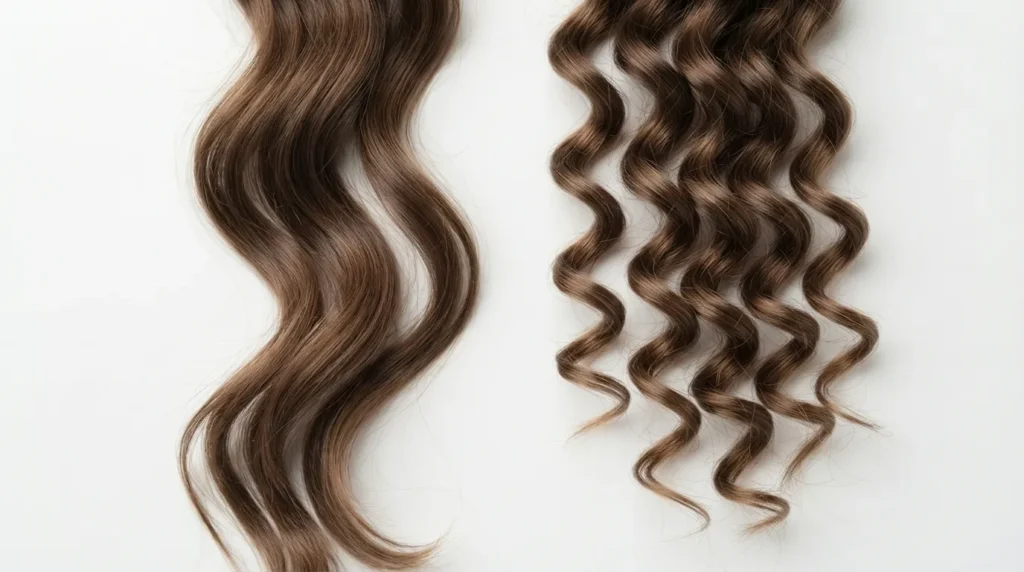
2C vs 3A Hair: Key Differences
| Feature | 2C Hair | 3A Hair |
|---|---|---|
| Curl pattern | Loose, defined waves | Loose, springy curls |
| Curl shape | Shallow “S” | Full ringlet |
| Curl diameter | Wide, sidewalk chalk or wider | Sidewalk chalk to marker width |
| Volume at root | Often flatter | Usually more lift |
| Frizz risk | High without moisture | Moderate, mostly humidity-driven |
| Best diffuser approach | Light scrunching, minimal disturbance | Cupping and holding for curl clump formation |
Knowing where each section of your hair sits on this chart helps you decide where to focus curl cream versus where a lighter leave-in conditioner is enough.
Best Wash Day Routine for 2C and 3A Hair
Worked example: Sarah has 2C waves on top and 3A curls at her nape. On wash day, she starts with a clarifying, sulfate-free shampoo focused only on her scalp, letting the lather rinse through the lengths. She follows with a rich conditioner, concentrated on the 3A sections where curls need more slip to detangle without breakage.
Cleansing and Conditioning
https://www.aad.org/public/everyday-care/hair-scalp-care/hair/curly-hair-care
Sulfate-free shampoo removes buildup without stripping the moisture balance that curl definition depends on. Focus cleansing at the scalp; let the suds carry down the rest of the hair naturally.
Deep conditioning once a week keeps both curl types hydrated. The looser 2C sections need less contact time, so apply conditioner unevenly on purpose — lighter up top, heavier at the ends and in denser 3A zones.
Applying Product on Wet Hair
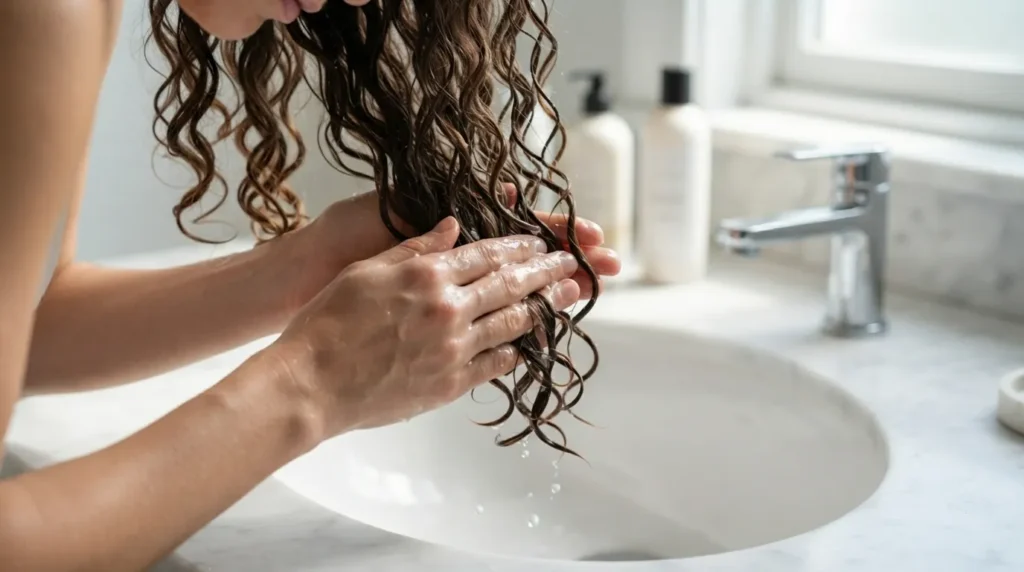
Product placement matters more than product choice. On soaking wet hair:
- Apply leave-in conditioner root to tip, working in sections
- Follow with a lightweight gel or curl cream on the 2C areas
- Use a slightly heavier curl cream on 3A sections to support the tighter curl’s shape
- Finger coil the curliest pieces to encourage clumping
This layered approach — sometimes called “LOC” (leave-in, oil, cream) or “LCO” — keeps a mixed curl pattern from frizzing in one zone while the other looks defined.
Diffusing vs. Air Drying
Air drying gives a natural, low-maintenance finish but can leave 2C waves looking limp if not scrunched properly while damp. A diffuser adds volume and speeds up curl formation, especially useful for lifting flatter 2C roots so they don’t get overshadowed by denser 3A curls elsewhere.
Diffuse on low heat, low speed, cupping sections and holding them toward the scalp rather than shaking the dryer around. This reduces frizz and protects curl clumps that are still forming.
Best Refresh Day Routine
Between wash days, a curl refresh restores definition without a full reset. Mix water with a small amount of leave-in conditioner in a spray bottle, mist dry hair section by section, and scrunch gently. Add a touch of gel only to areas that fell flat overnight, usually the crown.
Worked example: On day two, Marcus’s 3A curls at the back are still bouncy, but his 2C crown has gone flat from sleeping. He mists only the crown, scrunches in a pea-sized amount of gel, and diffuses for 30 seconds — leaving the rest of his routine untouched.
Best Products for 2C/3A Hair
Recommended Ingredients
- Glycerin (in low-humidity climates) for moisture retention
- Aloe vera for lightweight hydration without weighing down 2C sections
- Shea or mango butter in small amounts for 3A ends prone to dryness
- Flaxseed or aloe-based gels for hold without stiffness
Ingredients to Avoid
- Sulfates in daily cleansers — too stripping for a moisture-dependent curl pattern
- Heavy silicones (non-water-soluble) that build up and flatten curl definition over time
- High alcohol content in gels, which dries out porous strands
Lightweight products generally serve 2C sections best, while 3A curls can tolerate — and often need — slightly richer formulas to maintain their shape through the day.
Styling Tips for Mixed 2C and 3A Hair
Finger Coiling and Scrunching
Finger coiling — wrapping small sections around one finger while product is still wet — gives 3A curls extra definition and helps looser 2C strands commit to a curl shape instead of drying wavy and undefined. Scrunching from the ends upward, cupping the hair in your palm, works well across both textures and is faster for all-over application.
Plopping for Curl Definition
Plopping means wrapping damp hair in a microfiber towel or cotton T-shirt to encourage curl clumping without the friction of regular towel-drying. This method benefits a 2c 3a curl pattern especially well, since it reduces frizz on the looser sections while letting tighter curls settle into shape undisturbed. Plop for 10–20 minutes, then diffuse or air dry as usual.
Common Problems With 2C and 3A Hair (and How to Fix Them)
Uneven curl definition. The most frequent complaint with a mixed curl pattern — one section curls up nicely, another looks stringy. Fix this by applying more product to the looser 2C areas and using finger coiling there specifically.
Frizz in humid weather. Both curl types react to humidity, but 2C waves usually frizz first since they have less natural curl to hold shape. An anti-humidity leave-in or light gel cast helps seal the cuticle.
Product buildup weighing down curls. Rich products meant for 3A curls can overload finer 2C strands. Apply heavier creams only where needed, not uniformly across the whole head.
Curls falling flat by midday. Usually a sign of too much moisture and not enough hold. A light gel layered over leave-in conditioner, focused at the roots, extends definition through the day.
Nighttime Hair Protection
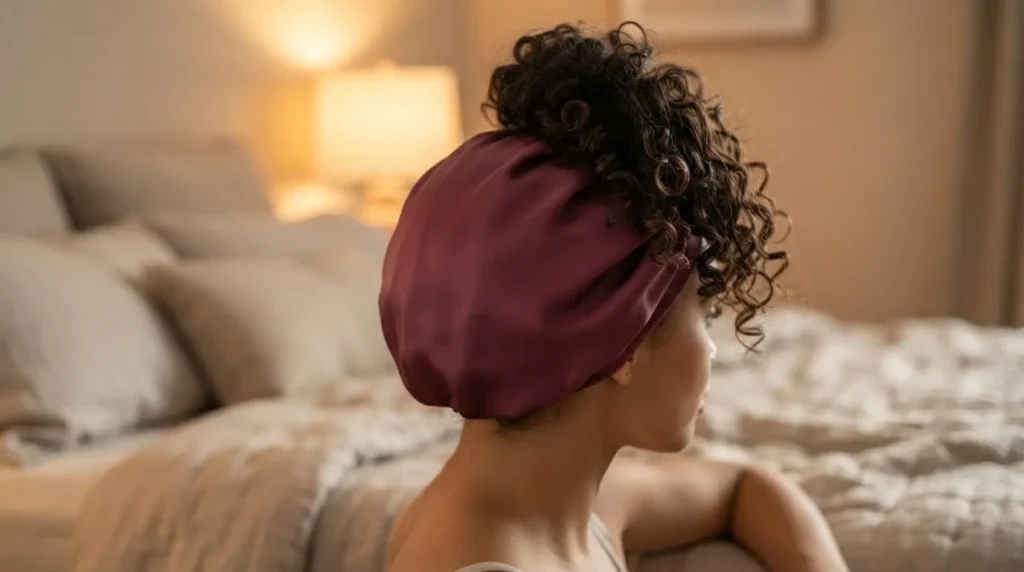
Friction from cotton pillowcases breaks down curl definition and causes frizz overnight. A silk or satin bonnet, or a silk pillowcase, preserves both curl types without flattening the crown.
Pineappling — gathering hair loosely on top of the head with a scrunchie — works well for a 2C and 3A hair mix because it protects length while letting shorter, curlier pieces near the face keep some shape. For very mixed textures, some people use two loose pineapples (one high, one lower at the crown) to avoid crushing denser curl clusters.
Mistakes to Avoid With a 2C 3A Curl Pattern
- Applying the same amount of product to every section, regardless of curl type
- Brushing dry curls, which breaks up clumps and creates frizz
- Skipping deep conditioning because “only some of it is really curly”
- Using high heat on a diffuser, which dries out looser waves before curls fully form
- Touching or scrunching hair while it dries — this is the single biggest cause of frizz across both curl types
Frequently Asked Questions
Am I 2C or 3A hair, or both?
Most people with this concern have both. Check different sections of your head separately — crown, sides, nape — since curl pattern often varies by zone rather than being uniform.
What’s the difference between 2C hair and 3A hair?
2C hair forms deep waves that curl mainly at the ends, while 3A hair forms full, springy ringlets from root to tip. 2C sits at the border of wavy and curly; 3A is fully curly.
How do I style 2C and 3A hair together?
Use a layered product routine — lightweight leave-in and gel on 2C sections, slightly richer cream on 3A sections — and apply while hair is fully wet to encourage even curl formation across both textures.
Can 2C hair turn into 3A hair over time?
Curl pattern can shift with hormonal changes, health, and even how hair is treated (heat damage, chemical processing), but it won’t permanently change from consistent care alone. Many people simply have both patterns naturally, not a hair “converting” over time.
What products work best for a 2c 3a hair mix?
Sulfate-free shampoo, a lightweight leave-in conditioner, and a curl cream or light gel layered by section — heavier product on 3A curls, lighter product on 2C waves — tends to work best.
Conclusion
A 2C and 3A hair mix isn’t a styling problem to solve — it’s a texture to work with. Once you know which sections lean wavy and which lean curly, product placement and technique do the rest. Treat each zone on its own terms, protect curls at night, and the mixed pattern that once felt hard to manage becomes one of the easiest things to style.
REad Next.
Pingback: Complete 2C Hair Care Guide: Routine, Products & Styling TipS
Pingback: 2C Hair Men: The Complete Care & Style Guide