

Table of Contents
2C Hairstyles Men: Best Curly Styles & Cuts
Men with naturally textured hair have plenty of styling options, but finding a cut that works with your particular curl pattern makes a major difference. 2C hairstyles men choose can range from clean fades and tapers to relaxed medium-length curls, layered shags, fringes, and longer styles.
2C hair sits between wavy and curly. It usually forms strong S-shaped waves with some loose curls, especially around the ends. Because it has noticeable texture and can develop frizz, the right haircut should work with the hair rather than forcing it into a completely different shape.
This guide covers the best curly hairstyles for men with 2C hair, how to choose a cut for your face shape and density, how to style natural curls, and what to tell your barber.
Understanding 2C Curly Hair for Men
What Is 2C Hair?
2C hair is a curl-pattern category characterized by strong waves that can form loose curls. Compared with 2A or 2B hair, 2C hair generally has more visible texture, more volume, and a stronger tendency to become frizzy when it is handled too much.
The pattern can vary across the head. The hair near the crown might look wavy while the sides or ends form tighter bends. Some men may even have sections that look closer to loose curls.
The goal is not to make every strand look identical. A good haircut enhances the natural pattern and gives the hair a balanced shape.
For example, a man with dense 2C hair may benefit from removing some bulk through strategic layers rather than cutting everything very short. Someone with finer hair may prefer a shorter curly top that creates the appearance of fullness.
2C Hair vs. Other Curl Patterns
Understanding your natural texture makes choosing a haircut much easier.
| Curl Pattern | Typical Appearance | Styling Priority |
|---|---|---|
| 2A | Very loose waves | Lightweight volume |
| 2B | Defined S-shaped waves | Definition and frizz control |
| 2C | Strong waves and loose curls | Definition, shape, and moisture |
| 3A | Clearly formed loose curls | Curl definition and hydration |
| 3B+ | Tighter curls | Moisture, shrinkage control, and definition |
These categories are useful guidelines rather than strict rules. Your hair can contain more than one pattern, and factors such as length, humidity, damage, and styling technique can change how the pattern looks.
How Hair Density and Texture Affect Your Style
Hair density describes how much hair you have overall, while texture describes characteristics such as strand thickness and natural movement.
Dense 2C hair can create impressive volume, but it may also become bulky around the sides. A layered haircut can distribute that volume more evenly.
Lower-density hair may benefit from keeping some length on top instead of removing too much bulk. A textured crop or short curly top can create structure without requiring complicated styling.
Practical example: If your curls look great on top but the sides become wide and heavy, ask your barber to reduce the excess bulk around the sides while preserving enough length for the natural pattern to form.
Best 2C Hairstyles Men Can Try
There is no single best haircut for every man with 2C hair. Your ideal choice depends on length, density, curl pattern, face shape, lifestyle, and how much time you want to spend styling.
Short Curly Hairstyles
Short curly hair is one of the easiest choices if you want a neat appearance with less daily maintenance.
A short curly top can be paired with tapered sides or a fade. Keeping some length on top allows the natural curls to remain visible instead of cutting the texture away completely.
A textured crop is another option. The top stays short enough to remain manageable while the natural texture provides visual interest.
Practical example: If you want a haircut that looks polished for school, work, or everyday activities without requiring a long styling routine, a short curly top with tapered sides is a practical starting point.
Medium-Length Curly Hairstyles
Medium-length curls give 2C hair more room to show its natural movement. This length can be especially useful if your waves become more defined as they grow.
A medium-length hairstyle can be worn naturally, pushed away from the face, parted to the side, or shaped into a loose fringe.
The main advantage is versatility. You can make the same haircut look casual with loose curls or more polished by controlling the front and sides.
Long Curly Hairstyles
Long curly hair creates movement and allows the natural texture to become the main feature of the style.
Longer 2C hair can be worn with a centre part, pushed back, or shaped with layers. Layers are particularly useful because they can prevent longer hair from becoming one heavy block.
Long hair does require more patience, however. Dryness and frizz become more noticeable when the ends are not cared for properly.
Practical example: If your curls become more defined when your hair grows past your ears, growing the top and adding subtle layers may give you a better result than repeatedly cutting it short.
Curly Top Fade

A curly top fade combines textured length on top with progressively shorter sides. The contrast makes the curls more noticeable.
The amount of length left on top can vary. A shorter top creates a sharper appearance, while more length produces a softer and fuller look.
This is a strong option if you want the visual impact of curls without maintaining a lot of hair around the sides.
Curly Taper Fade
A curly taper fade is a cleaner alternative when you do not want the sides completely faded.
The barber gradually reduces the hair around areas such as the temples and neckline while leaving more natural weight elsewhere. This can make the haircut look polished without taking away the character of the curls.
It works particularly well for men who want a hairstyle that transitions easily between casual and professional settings.
Curly Fringe
A curly fringe allows the front of the hair to fall naturally toward the forehead.
The fringe can be short and controlled or longer and more relaxed. The right length depends on your curl pattern because curly hair can appear shorter once it dries.
A barber should account for this when determining the final length.
Curly Quiff
A curly quiff adds height and direction to the front while keeping the natural texture visible.
Instead of straightening the curls, use their movement to create volume. A lightweight styling cream can help the curls group together while maintaining a natural finish.
This style works particularly well when you want something more structured than a completely messy curly top.
Curly Shag
A curly shag uses layers to create movement throughout the haircut.
For 2C hair, the layers can help prevent the ends from becoming excessively heavy. The result is relaxed, textured, and intentionally undone.
It is a good choice for someone who prefers natural texture over an extremely precise finish.
Curly Mullet
A curly mullet combines shorter hair around the front and sides with additional length toward the back.
The natural movement of 2C hair can make this style look softer than a straight-hair version. Layers help the transition between sections feel intentional.
Because the shape is distinctive, it is worth bringing several reference photos to your barber.
Curly Undercut
A curly undercut creates a noticeable separation between the longer top and much shorter sides.
The contrast can make medium or long curls look fuller on top. However, this style has a stronger visual effect than a taper, so it may not be ideal if you want a subtle haircut.
Curly Crew Cut
A curly crew cut keeps the hair relatively short while leaving enough texture to show the natural pattern.
This is one of the lower-maintenance choices for men who prefer a neat shape. The main consideration is not cutting the top so short that the curls lose their definition.
Textured Crop
A textured crop works well for short 2C hair because the haircut itself creates structure.
The top can be left slightly longer and shaped into a natural forward direction. The sides can be tapered or faded depending on how sharp you want the result.
This is especially useful for someone who does not want a long styling routine.
Curly Side Part
A side part gives naturally curly hair a more organized appearance.
Rather than creating a perfectly straight part, the barber can work with your natural growth direction. This makes the style easier to maintain and prevents excessive manipulation.
A small amount of styling cream can keep the curls grouped while maintaining movement.
Layered Curly Hair
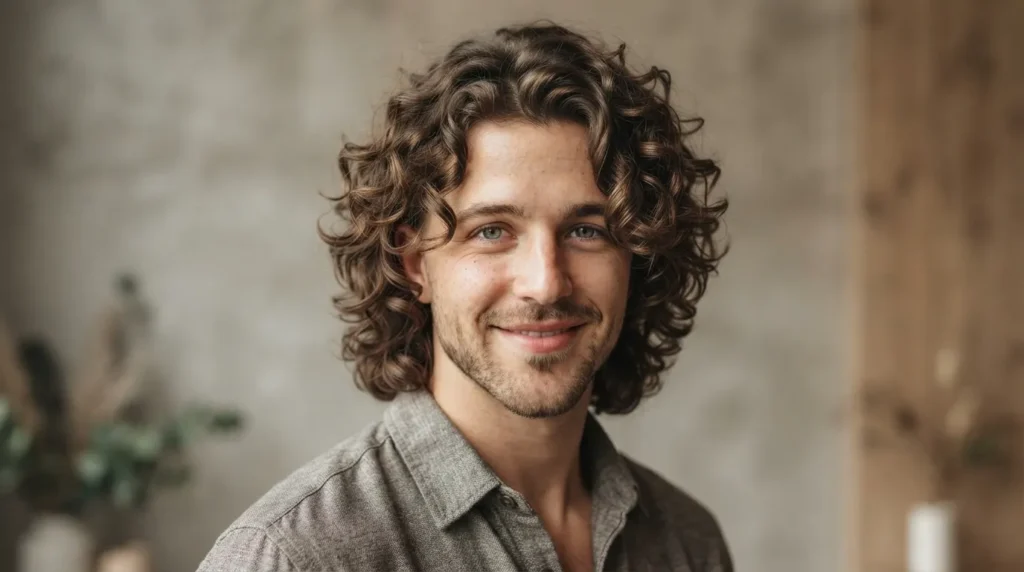
Layers are valuable when curly hair becomes heavy or loses shape.
Instead of removing large amounts of hair randomly, a barber can use layers to distribute volume and encourage movement. The technique should match your density and desired length.
For dense 2C hair, layers can make medium or long styles feel lighter without sacrificing the overall length.
Curly Pompadour
A curly pompadour uses height and volume at the front while keeping the sides more controlled.
The style works best when the hair has enough density and length to create the required shape. Rather than brushing the curls completely straight, allow some natural texture to remain visible.
This creates a modern version of the classic pompadour.
How to Choose the Right Curly Hairstyle
Choosing a haircut is easier when you consider more than the hairstyle name. Two men can request the same curly fade and get very different results because their hair density, face shape, and curl pattern differ.
Choosing a Style for Your Face Shape
Face shape can help you decide where to add or reduce visual volume.
| Face Shape | Styles to Consider | General Approach |
|---|---|---|
| Oval | Most curly styles | Keep proportions balanced |
| Round | Curly quiff, curly top fade | Add controlled height |
| Square | Taper, textured crop, medium curls | Work with strong facial angles |
| Long | Fringe, side part, medium curls | Avoid excessive height |
| Heart | Layered curls, fringe, medium styles | Balance the forehead and chin |
These are guidelines rather than strict rules. Your natural hair behavior should remain the priority.
Practical example: If you have a longer face and naturally tall curls, a curly fringe can add visual balance by bringing some texture toward the forehead rather than adding more height.
Choosing a Style for Hair Density
High-density hair gives you more volume but may require more shaping.
Low-density hair can benefit from styles that avoid excessive thinning. Removing too much hair can make the overall shape appear less substantial.
Tell your barber whether your hair tends to feel thick, medium, or fine. This information can change how much hair should be removed.
Choosing Between Short, Medium, and Long Curls
Choose short hair if you want simplicity and frequent shape control.
Choose medium length if you want versatility and noticeable curl movement.
Choose long hair if you enjoy a more natural appearance and are willing to spend additional time maintaining the ends.
There is no universal winner. The best length is the one that works with your natural curl pattern and daily routine.
Low-Maintenance vs. Defined Styles
A low-maintenance hairstyle does not necessarily mean doing nothing to your hair.
Short cuts usually require less styling time, but regular barber visits may be needed to maintain the shape.
Longer curls may need less frequent cutting but more attention after washing.
Think about your actual routine before choosing the haircut.
How to Style 2C Curly Hair for Men
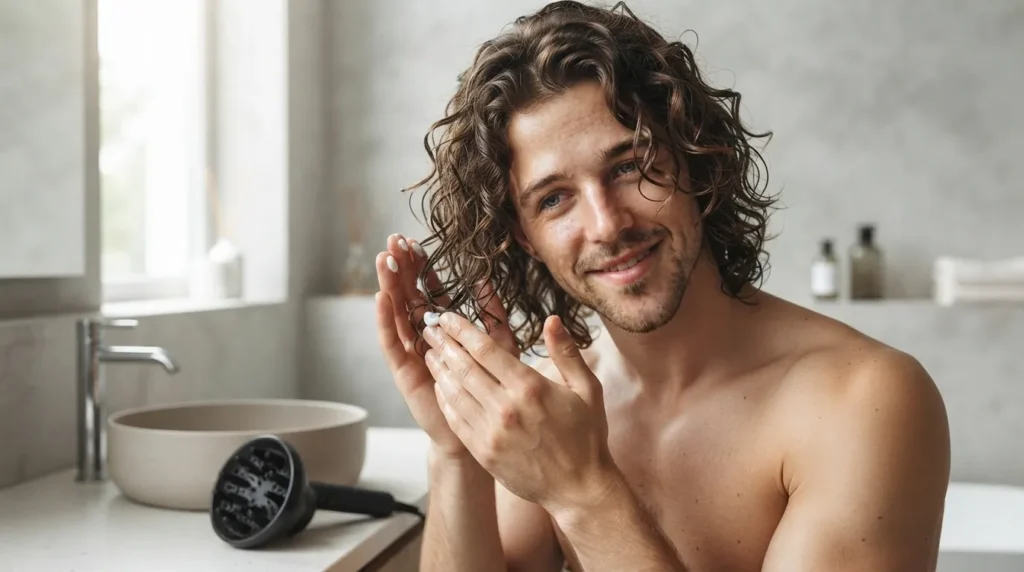
A good haircut creates the foundation, but styling technique determines how much of your natural curl pattern becomes visible.
Start With Damp Hair
After washing or refreshing your hair, gently remove excess water without aggressively rubbing the curls.
Apply your chosen styling product while the hair is still damp. This helps distribute the product through the hair before it dries.
A curl-enhancing cream can provide light definition while keeping the finish flexible.
Build Curl Definition Without Crunch
The goal is to encourage curls to form together rather than coating the hair with too much product.
Start with a small amount of styling cream. Spread it through your hands first, then distribute it through the mid-lengths and ends.
If more control is needed, add a little more rather than applying a large amount at once.
Practical example: If your hair is medium length, start with a small amount of product. Scrunch the damp curls gently, let them begin forming, and only add more product if the finished result needs additional definition.
Control Frizz and Preserve Natural Texture
Frizz is often more noticeable when curly hair is repeatedly touched during drying.
Try to minimize handling once the curls have been shaped. Excessive brushing after the hair has started drying can break apart curl groups and create a fuzzy appearance.
Moisture also matters. Hair that feels consistently dry may need a more conditioning routine rather than simply more styling product.
Air-Drying vs. Using a Diffuser
Air-drying is simple and requires no heat tool. It can work well when you have enough time to let your curls dry naturally.
A diffuser can speed up drying while helping maintain the curl pattern when used carefully.
Keep the airflow controlled and avoid constantly disturbing the curls.
If you use heat, follow the instructions for your specific tool and avoid unnecessarily high temperatures.
Creating Volume and Hair Movement
For more volume, focus on the roots rather than adding large amounts of product to the ends.
A diffuser can help lift the roots while the curls dry. You can also position your hair differently before it dries to influence the final direction.
The key is to avoid overworking the hair. Natural movement usually looks better than a rigid shape.
What to Ask Your Barber for a Curly Haircut
Knowing the name of a haircut is helpful, but describing how your hair behaves is even more useful.
How to Explain Your Curl Pattern
Tell your barber that your hair is around the 2C range if that description fits your hair.
Explain whether your hair becomes curlier when it grows, whether it expands when dry, and where you experience the most volume.
Also mention whether you normally style it naturally or prefer a controlled finish.
How to Ask for a Fade or Taper
Be specific about how much contrast you want.
A low taper creates a more subtle transition. A stronger fade creates more contrast between the sides and the curly top.
Instead of saying only “give me a curly fade,” explain the approximate amount of length you want to keep on top and whether you want the sides subtle or dramatic.
Why Layers Matter for Curly Hair
Layers can change how curls sit against each other.
Without enough shaping, dense curly hair can form a heavy triangular silhouette. Properly placed layers can distribute the volume and encourage movement.
However, excessive layering can make the hair look uneven, particularly if the hair is fine.
What to Bring to Your Appointment
Reference photos are extremely useful.
Bring photos showing the overall shape, the sides, and the back. If possible, choose examples where the person’s curl pattern is reasonably similar to yours.
Also explain how much time you are realistically willing to spend styling your hair.
Practical example: If you show a barber a photo of a medium curly hairstyle but tell them you only want five minutes of daily styling, they can adjust the cut to make the target shape easier to maintain.
Best Curly Hairstyles for Different Occasions
Professional Curly Hairstyles
For professional environments, a curly taper, side part, controlled curly top, or medium-length layered style can provide structure without removing your natural texture.
The goal is usually a clean outline and controlled volume rather than perfectly uniform curls.
A small amount of styling cream can help keep the shape together while maintaining movement.
Casual Curly Hairstyles
Casual styles give you more freedom to embrace natural texture.
Curly shags, messy curly tops, medium curls, fringes, and layered styles can all work well.
A relaxed finish does not mean the haircut should be shapeless. Good layering and a clean outline provide structure underneath the natural texture.
Easy Everyday Curly Hairstyles
If convenience matters most, consider a short curly top, crew cut, textured crop, or taper.
These styles generally require less manipulation than long curls.
For example, someone who exercises frequently or has a busy schedule may prefer a shorter cut that can be refreshed quickly with water and a small amount of styling product.
Curly Hair Maintenance and Common Mistakes
A good curly haircut can lose its shape if your maintenance routine constantly works against your natural texture.
How Often to Get a Haircut
The ideal schedule depends on the haircut.
A fade or taper usually needs more frequent maintenance because the shorter sides show growth quickly.
Medium and long layered hairstyles can often go longer between shape-ups.
Instead of following a fixed calendar, pay attention to when the outline stops looking intentional.
Avoiding Overwashing
Curly and wavy hair can feel dry when it is washed too aggressively or too frequently.
Your ideal washing schedule depends on your scalp, activity level, products, and environment.
Focus on keeping the scalp clean while avoiding unnecessary handling of the lengths.
Avoiding Too Much Product
More product does not automatically create better curls.
Too much styling cream can weigh down 2C hair and reduce its natural volume.
Start small and build gradually. This makes it easier to find the amount that gives definition without leaving the hair heavy.
Protecting Curl Definition Between Washes
On non-wash days, you may be able to refresh the hair with a small amount of water and a lightweight product.
Avoid repeatedly brushing dry curls unless the style specifically requires it.
Instead, reshape individual sections with damp hands when necessary.
Quick Reference: Choosing Your Best Curly Style
| Your Priority | Good Starting Options | Why |
|---|---|---|
| Low maintenance | Crew cut, textured crop, short curly top | Simple daily styling |
| Clean appearance | Curly taper, side part | Controlled shape |
| Maximum texture | Curly shag, layered curls | Highlights natural movement |
| Strong contrast | Curly fade, undercut | Makes the top stand out |
| More volume | Curly quiff, curly top fade | Adds height and presence |
| Longer natural look | Medium or long layered curls | Preserves movement |
| Fringe-focused look | Curly fringe | Frames the forehead |
| Distinctive style | Curly mullet | Strong shape and personality |
Practical example: If your priority is a professional appearance with minimal styling, a curly taper with a medium-length top is a better starting point than a long curly mullet. If your priority is natural movement and individuality, the opposite may be true.
Frequently Asked Questions About 2C Hairstyles for Men
What is the best haircut for 2C hair men?
There is no single best haircut for every man with 2C hair. A curly taper, textured crop, curly top fade, layered medium style, or curly fringe can all work depending on hair density, face shape, and desired maintenance.
For a first haircut, a medium curly top with controlled sides is often a versatile option because it preserves enough length to see how your natural pattern behaves.
Is 2C hair curly or wavy?
2C hair is generally considered wavy rather than fully curly, but it sits close to the curly end of the wavy spectrum.
It often forms strong S-shaped waves and loose curls. Some sections may look curlier than others, particularly as the hair grows.
Are fades good for 2C curly hair?
Yes. Fades can work very well with 2C hair because the shorter sides create contrast with the textured top.
A low fade or taper gives a more subtle result, while a higher fade produces a stronger contrast.
The best choice depends on how much side volume you want to keep.
How do men make 2C curls more defined?
Start with damp hair, use an appropriate curl-defining product sparingly, gently encourage the natural curl pattern, and avoid excessive touching while the hair dries.
The haircut also matters. Layers and the right amount of length can help the natural pattern form more clearly.
Is short or long hair better for 2C curls?
Both can work.
Short hair is easier to manage and can create a cleaner appearance. Longer hair gives 2C waves more room to develop and creates additional movement.
Medium length is often a useful middle ground because it provides visible texture without requiring the maintenance of very long curls.
How do you control frizz in men’s curly hair?
Use a gentle hair-care routine, avoid excessive brushing of dry curls, apply styling products to damp hair, and minimize unnecessary touching while the hair dries.
If your hair consistently feels dry, consider whether your routine needs more conditioning rather than simply adding more styling product.
How often should men with curly hair get a haircut?
It depends on the style.
Fades and tapers generally need more frequent shape-ups, while medium and long curly hairstyles can often grow out for longer before needing a full haircut.
Book a trim when the shape becomes difficult to control or the ends no longer sit the way you want.
Conclusion
The best 2C hairstyles men choose should work with their natural texture rather than fight it. Whether you prefer a curly taper, textured crop, medium-length layers, curly fringe, quiff, shag, or longer curls, the right combination of length, shape, and styling can make your natural pattern easier to manage. Start with your curl behavior, hair density, face shape, and daily routine, then choose a haircut that makes those features work in your favor.
Reasd Next
Pingback: 2C Low Porosity Hair: Complete Care Guide